RTL-SDR Blog V4
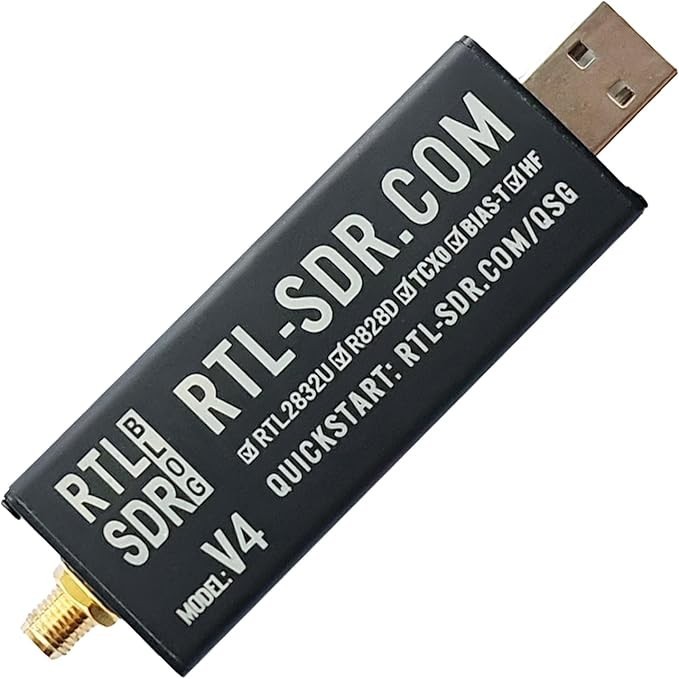
The RTL-SDR Blog V4 is the canonical $35 software-defined radio dongle — an R828D tuner and RTL2832U demodulator in a shielded metal enclosure with a built-in HF upconverter, USB-A interface, and a 0.5 PPM TCXO. It receives 500 kHz to 1.75 GHz, including HF, without an external upconverter, and runs in SDR#, SDR++, GQRX, and CubicSDR on Windows, macOS, Linux, and Android.
The default first SDR for almost everyone — skip only if you already know you need TX or sub-Hz HF performance.
Where to Buy
Pros
- Built-in HF upconverter receives 500 kHz to 24 MHz directly — no external upconverter required
- 0.5 PPM TCXO eliminates the frequency drift that plagued V3 and earlier dongles
- Switchable bias tee powers active antennas without modification
- Full metal enclosure with internal shielding keeps strong local FM stations from desensing the front end
- Works in every major SDR application — SDR#, SDR++, GQRX, CubicSDR, GNU Radio, SDRangel
Cons
- Receive-only — for TX you need a HackRF One, PlutoSDR, or LimeSDR
- 8-bit ADC limits dynamic range vs. 16-bit receivers like the Airspy HF+
- USB-A plug is awkward on modern laptops — needs a hub or extension cable for thermal isolation
What the V4 fixed from earlier dongles
The original RTL-SDR dongles were repurposed European DVB-T TV tuners that happened to expose raw IQ samples. They worked, but with serious caveats: ±50 PPM frequency error that drifted with temperature, no shielding (a strong local FM station 5 miles away would crush the entire UHF spectrum with intermod), and no native HF coverage below 24 MHz.
The Blog V4 fixes all three. The 0.5 PPM TCXO holds frequency to within a few Hz even as the dongle warms up — critical for narrowband modes like SSB and digital protocols that fail with a few hundred Hz of drift. The full metal enclosure plus internal shielding around the tuner section keeps strong FM broadcasts out of the IF chain. And the built-in HF upconverter puts the 500 kHz to 24 MHz HF range directly into the V4's normal tuning, with software in SDR++ and SDR# handling the offset automatically. Earlier RTL-SDRs needed an external $40 Ham-It-Up upconverter board plus a separate antenna feed — the V4 just works.
Software setup and the first 30 minutes
On Windows, the path is Zadig (USB driver replacement) → SDR# or SDR++ → load the rtl-sdr source. On macOS, install librtlsdr via Homebrew, then run GQRX or CubicSDR. On Linux, the rtl-sdr package is in every distribution's repository. The V4 plugs in, gets recognized, and is tuning broadcast FM in under 10 minutes. The harder part is the antenna.
The stock dipole antenna in the V4 kit (when purchased with the kit option) works for VHF and UHF — broadcast FM, NOAA weather satellites (137 MHz), pager decoding (138 MHz), aircraft VHF (118-137 MHz). For HF reception below 30 MHz you need a long-wire antenna (a 10-meter wire thrown over a tree branch works), a balun, and ideally a ground rod. The V4's HF performance is bottlenecked by antenna quality, not the dongle itself — a $30 magnetic-loop HF antenna outperforms any indoor wire by 20-30 dB on weak signals.
ADS-B, NOAA, and what most people use it for
The single most popular RTL-SDR project is ADS-B aircraft tracking. The dongle plugs into a Raspberry Pi, runs dump1090 or readsb, and feeds aircraft position data to FlightAware, FlightRadar24, or a local map. A V4 with the included telescoping dipole receives aircraft from 100+ nautical miles in flat terrain. Feeding FlightAware earns you a free Enterprise account, which is the typical hobbyist's first 'why did I buy this' payoff.
The second most popular project is NOAA weather satellite reception. NOAA 15, 18, and 19 transmit at 137 MHz APT (analog) and pass overhead every 100 minutes or so. A simple V-dipole tuned to 137 MHz plus the V4 plus WXtoImg (or NOAA-APT on Linux) decodes color weather images of your region in real time. The pass takes 12-15 minutes; setup is one afternoon. A third common project is trunked radio monitoring — police and public-safety systems use Motorola Type II, P25 Phase I/II, DMR, and NXDN, all of which decode with SDR++ plus DSDPlus or OP25.
Full Specifications
Connectivity
| Specification | Value |
|---|---|
| rx_frequency_range | 500 kHz – 1.75 GHz (HF via built-in upconverter) [1] |
| max_sample_rate | 3.2 MSPS (2.4 MSPS stable) [1] |
| tx_capability | Receive-only [1] |
| adc_bits | 8-bit [1] |
| ADC Channels | 1 (I/Q quadrature) [1] |
| reference_clock | 0.5 PPM TCXO [1] |
| hf_reception | Built-in HF upconverter (no external upconverter needed) [1] |
I/O & Interfaces
| Specification | Value |
|---|---|
| antenna_connector | SMA female [2] |
| USB | USB-A (Type-A plug) [2] |
| bias_tee | Yes (switchable 4.5V via software) [2] |
Physical
| Specification | Value |
|---|---|
| shielding | Full metal enclosure with internal shielding [2] |
| Dimensions | 69 x 27 x 13 mm [2] |
| weight_g | 42 g [2] |
| Form Factor | USB dongle with metal enclosure [2] |
Who Should Buy This
The reference $35 dongle. Works with every tutorial on the internet. The built-in HF upconverter means a single purchase covers shortwave, HF ham bands, FM, NOAA sats, ADS-B, and trunked radio. No other dongle at this price covers HF natively.
The 8-bit ADC and bridged HF upconverter limit weak-signal performance below 30 MHz. The Airspy HF+ Discovery has an 18-bit ADC, ±0.5 PPM TCXO, and dedicated HF/VHF front ends — it pulls out signals the RTL-SDR loses in the noise floor.
Better alternative: Airspy HF+ Discovery
RTL-SDR is receive-only. The HackRF One transmits 1 MHz to 6 GHz at up to 1 mW — adequate for IoT protocol replay, GSM analysis, and ISM-band experimentation in shielded environments.
Better alternative: HackRF One
Frequently Asked Questions
Does the RTL-SDR Blog V4 receive HF without an external upconverter?
Yes. The V4 has a built-in HF upconverter that covers 500 kHz to 24 MHz directly. This is the headline difference from V3 and earlier dongles, which required a separate $40 Ham-It-Up upconverter board.
Can the RTL-SDR transmit?
No. The RTL-SDR is receive-only by hardware design. For transmitting you need a HackRF One (1 MHz to 6 GHz, half-duplex), PlutoSDR (70 MHz to 6 GHz, full duplex), or a LimeSDR. RTL-SDR cannot be modded into a transmitter.
RTL-SDR Blog V4 vs older V3 dongles?
V4 adds built-in HF upconverter (V3 required external Ham-It-Up), upgrades the tuner to Rafael Micro R828D, improves sensitivity above 1 GHz, and uses an SMA female connector (V3 was MCX). V4 needs updated drivers — the old rtl-sdr drivers from 2018 do not recognize it.
What antenna comes with the RTL-SDR Blog V4 kit?
The official kit ships with a dipole kit (two telescoping whips, a tripod mount base, SMA cables, suction-cup mounts). It works well for VHF and UHF: broadcast FM, NOAA weather sats, aircraft VHF, pager bands. For HF below 30 MHz you need a longer external antenna.
Can I run multiple RTL-SDR dongles on one computer?
Yes, on Linux and Windows. Each dongle is identified by serial number; SDR++, GQRX, and SDRangel all support multiple radios. Common applications: one for ADS-B, one for NOAA pass automation, one for general listening. USB-A power can become limiting — use a powered hub.
Does it work on a Raspberry Pi?
Yes. Raspberry Pi is the most common host for V4 dongles, especially for headless ADS-B and ACARS feeders. Pi 4 and Pi 5 handle multi-stream decoding fine; Pi Zero 2 W handles single-stream dump1090 acceptably. The librtlsdr package installs from apt on Raspberry Pi OS.
Compared In
RTL-SDR Blog V4 appears in 5 buying guides on PAM Finds. These weigh it directly against the alternatives.