Seeed Studio XIAO ESP32S3
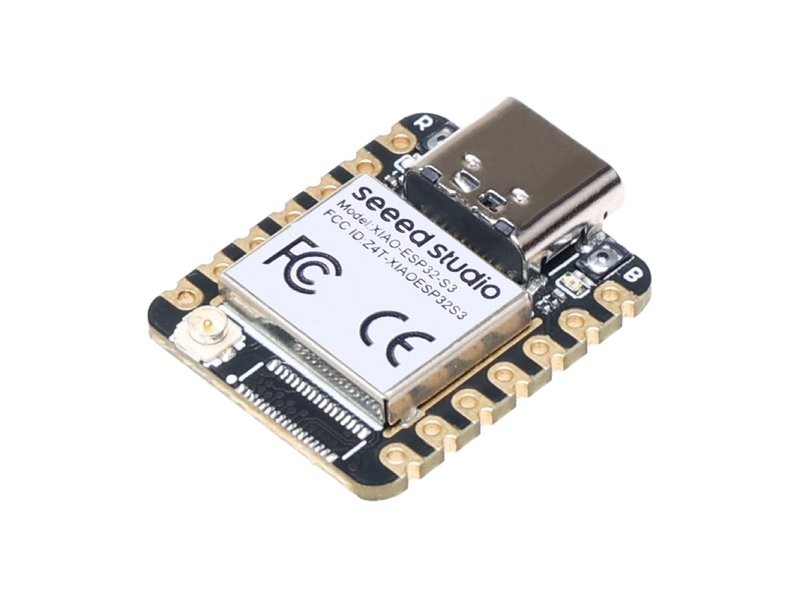
The Seeed Studio XIAO ESP32S3 packs the full ESP32-S3 feature set — dual-core LX7, 8MB PSRAM, WiFi, BLE 5.0 — into a 21x17.5mm package with USB-C and battery charging. It is the smallest ESP32-S3 board available, ideal for space-constrained wearables, compact sensors, and projects where every millimeter matters.
Best for ultra-compact projects needing ESP32-S3 power, skip if you need more than 11 GPIO pins.
Where to Buy
Pros
- 21x17.5mm footprint — smallest ESP32-S3 board available
- Full ESP32-S3 specs: dual-core LX7 at 240MHz, 8MB flash, 8MB PSRAM
- Built-in LiPo battery charging circuit for portable projects
- USB-C with OTG support — modern and reversible connector
Cons
- Only 11 GPIO pins exposed — severely limits multi-peripheral projects
- No breadboard-friendly pin header without a breakout board
- Camera connector only on the Sense variant (sold separately)
Form Factor
At 21x17.5mm, the XIAO ESP32S3 is roughly the size of a US postage stamp. Seeed's XIAO form factor has castellated pads on the edges rather than through-hole pins, making it suitable for surface-mount soldering onto a carrier PCB or use with the XIAO expansion board. The castellated pads allow reflow soldering in production, making the XIAO viable as a drop-in WiFi/BLE module on custom PCBs — a role typically filled by bare ESP32-S3-WROOM modules that require more complex integration.
The compact size comes at a cost: only 11 GPIO pins are accessible. This is enough for 1-2 SPI devices, an I2C bus (supporting up to 127 devices), and a couple of digital I/O lines, but multi-sensor projects requiring independent digital pins will quickly exhaust available connections. The ESP32-S3-DevKitC exposes 45 GPIO pins from the same chip. For projects needing more I/O while keeping a small form factor, the Adafruit QT Py ESP32-S3 at 22x17.8mm offers 13 GPIO pins plus a STEMMA QT connector, though it typically lacks PSRAM.
Seeed's XIAO expansion board adds breadboard-compatible headers, a 0.96-inch OLED display, a MicroSD card slot, an RTC clock, a buzzer, and Grove connectors for $12, turning the tiny XIAO into a prototyping platform. This modular approach lets you develop with full peripherals and then deploy the bare XIAO in a compact enclosure.
Full S3 Performance in a Tiny Package
Despite the small footprint, the XIAO ESP32S3 runs the same dual-core Xtensa LX7 at 240MHz with 8MB flash and 8MB PSRAM as the full DevKitC. Processing performance, memory capacity, and wireless capabilities are identical to Espressif's reference design. The 8MB octal-SPI PSRAM provides the same bandwidth for frame buffers, ML model weights, and large data structures.
This means the XIAO can run the same firmware, the same ML models, and the same WiFi/BLE stacks as the DevKitC. TensorFlow Lite Micro for keyword spotting, ESP-DL for image classification, ESPHome for home automation — all compile and run identically on both boards. The only real difference is pin availability and the physical form factor. For projects where you write firmware on the DevKitC's 45 GPIO pins and deploy on the XIAO, the code port is trivial — just remap the GPIO assignments in your configuration.
The XIAO ESP32S3 Sense variant is worth specific mention: it adds an OV2640 camera module and a digital PDM microphone onto the same 21x17.5mm footprint. This makes it the smallest ESP32-S3 camera board available, capable of MJPEG streaming at 10-12 FPS at VGA resolution over WiFi. For tiny surveillance cameras, doorbell prototypes, or voice-activated devices, the Sense variant provides capabilities that normally require a board three times its size.
Battery Integration
The built-in LiPo charging circuit accepts a single-cell 3.7V lithium battery (LiPo or Li-Ion) and charges at up to 100mA via the USB-C port. Power path management allows the board to run from USB power while charging the battery simultaneously. A battery voltage divider is connected to an ADC pin, enabling firmware to read battery level for low-power alerts or adaptive behavior.
Deep sleep current is approximately 14uA — higher than the ESP32-S3-DevKitC's 7uA due to the additional charging IC, voltage regulator quiescent current, and power management components on the board. With a 600mAh LiPo (a common size that fits behind the XIAO in compact enclosures), deep sleep lasts approximately 1,700 hours or about 70 days. In a practical ESPHome configuration waking every 5 minutes to report sensor data via WiFi, a 600mAh battery lasts 3-5 days.
For ultra-low-power sensors that need to last years on a coin cell, the ESP32-C3 at 5uA deep sleep is a better match — but it lacks the S3's dual-core power, PSRAM, and camera capability. The XIAO's battery integration is optimized for portable devices that recharge regularly (wearables, portable instruments, field tools) rather than deploy-and-forget sensor nodes.
Seeed XIAO Platform: Tiny but Capable
The XIAO is not a single board — it is a platform. Seeed Studio maintains a consistent 21x17.5mm footprint across the entire XIAO family: XIAO ESP32S3, XIAO ESP32C3, XIAO RP2040, XIAO SAMD21, and XIAO nRF52840. Every XIAO shares the same castellated pad layout, the same USB-C position, and the same mechanical mounting holes. This means the XIAO expansion board, custom carrier PCBs, and 3D-printed enclosures designed for one XIAO work with all of them. A project can start on the XIAO RP2040 for basic prototyping, swap to the XIAO ESP32S3 for WiFi and camera capabilities, and never change the enclosure or carrier board.
The XIAO ESP32S3 Sense variant is the standout configuration in the family. It adds an OV2640 camera module (2MP, up to 1600x1200 resolution) and a digital PDM microphone directly onto the 21x17.5mm form factor via a detachable add-on board. This makes the Sense variant the smallest ESP32-S3 camera board available — capable of MJPEG streaming at 10-12 FPS at VGA (640x480) resolution over WiFi, or capturing still images at full 1600x1200 to a MicroSD card. The 8MB PSRAM handles frame buffering without issue, and the dual-core LX7 dedicates one core to image capture while the other manages WiFi transmission. For tiny surveillance cameras, time-lapse photography rigs, or QR code scanners embedded in kiosks, the Sense variant delivers capabilities that normally require a board 3-4x its size.
The head-to-head comparison with the Adafruit QT Py ESP32-S3 is the most common buying decision for compact S3 projects. Both boards use the same ESP32-S3 chip at 240MHz, both have USB-C with OTG support, and both occupy nearly identical footprints (21x17.5mm XIAO vs 22x17.8mm QT Py). The differences come down to ecosystem and hardware extras. The XIAO includes 8MB PSRAM on the standard variant — the QT Py does not (PSRAM requires the less-common N8R2 SKU). The XIAO has built-in battery charging — the QT Py does not. The XIAO offers the Sense camera variant — the QT Py has no camera option. The QT Py counters with a built-in STEMMA QT/Qwiic connector for tool-free I2C sensor attachment, first-class CircuitPython support with drag-and-drop .py deployment, and access to Adafruit's 300+ learning guides.
The XIAO wins on raw hardware value: more memory, battery charging, and camera capability at a lower typical street price ($7-9 vs $10-13 for the QT Py). The QT Py wins on developer experience for beginners: plug-and-play STEMMA QT sensors, CircuitPython's zero-toolchain workflow, and Adafruit's tutorial depth. For Seeed's Grove ecosystem — which includes 300+ sensor modules using a 4-pin connector system — the XIAO pairs with the XIAO expansion board to access Grove peripherals with the same plug-and-play convenience that STEMMA QT provides for the QT Py. Price-sensitive projects, camera applications, and battery-powered deployments favor the XIAO. Education-focused projects, rapid I2C sensor prototyping, and CircuitPython-first workflows favor the QT Py.
Full Specifications
Processor
| Specification | Value |
|---|---|
| Architecture | Xtensa LX7 [1] |
| CPU Cores | 2 [1] |
| Clock Speed | 240 MHz [1] |
Memory
| Specification | Value |
|---|---|
| Flash | 8 MB [1] |
| SRAM | 512 KB [1] |
| PSRAM | 8 MB [1] |
Connectivity
| Specification | Value |
|---|---|
| WiFi | 802.11 b/g/n [1] |
| Bluetooth | 5.0 [1] |
I/O & Interfaces
| Specification | Value |
|---|---|
| GPIO Pins | 11 [2] |
| ADC Channels | 9 [2] |
| SPI | 1 [2] |
| I2C | 1 [2] |
| UART | 1 [2] |
| USB | USB-C (OTG) [2] |
| Camera Connector | OV2640 connector (Sense variant) [2] |
Power
| Specification | Value |
|---|---|
| Input Voltage | 5 V [1] |
| Deep Sleep Current | 14 uA [1] |
| Battery Charging | Yes [1] |
Physical
| Specification | Value |
|---|---|
| Dimensions | 21 x 17.5 mm [2] |
| Form Factor | XIAO (ultra-compact) [2] |
Who Should Buy This
21x17.5mm is small enough to embed in a tracker housing. Battery charging built in. UART for GPS module, WiFi for data upload. 8MB PSRAM for route logging.
11 GPIO pins run out fast. No standard breadboard spacing. The ESP32-S3-DevKitC has 45 GPIOs and fits a breadboard directly.
Better alternative: ESP32-S3-DevKitC-1
The XIAO ESP32S3 Sense variant includes an OV2640 camera and microphone in the tiny package. If you need the camera, buy the Sense version specifically.
Small enough for a wristband housing. Battery charging circuit handles LiPo management. BLE 5.0 for phone connectivity. 8MB PSRAM buffers sensor data between syncs.
Ecosystem & Community
The XIAO ESP32S3 benefits from Seeed Studio's Grove ecosystem with 300+ compatible modules, plus the full arduino-esp32 library support shared across all ESP32-S3 boards.
Compatible Software
What to Build First
Build an ultra-compact WiFi camera using the XIAO ESP32S3 Sense variant's built-in OV2640 camera. Stream MJPEG to a browser or capture periodic images to a MicroSD card — all in a 21x17.5mm package.
View tutorial →Must-Have Accessories
Video Reviews & Tutorials

Tutorials & Resources
- XIAO ESP32S3 Getting Started (Seeed Wiki)Official wiki with pinout diagrams, Arduino setup, and project examples for the XIAO ESP32S3tutorial
- ESP32-S3 XIAO Camera and Video StreamingStep-by-step guide to building a WiFi camera web server with the XIAO ESP32S3 Sensetutorial
Frequently Asked Questions
How does the XIAO ESP32S3 compare to the DevKitC?
Same chip, same performance. The XIAO is 3x smaller (21x17.5mm vs 69x25.4mm) with battery charging built in, but exposes only 11 GPIO pins versus the DevKitC's 45. Choose the XIAO for compactness, the DevKitC for prototyping flexibility.
Can the XIAO ESP32S3 use a camera?
The standard XIAO ESP32S3 does not have a camera connector. The XIAO ESP32S3 Sense variant includes an OV2640 camera module and digital microphone. It is a separate product you need to purchase specifically.
Does the XIAO fit on a breadboard?
Not directly — it uses castellated pads, not standard 0.1 inch through-hole pins. Seeed sells a XIAO expansion board that adds breadboard-compatible headers, Grove connectors, and a small OLED display.
What battery does the XIAO ESP32S3 use?
A single-cell 3.7V LiPo or Li-Ion battery. The built-in charging circuit handles charging via USB-C. There is a battery connector pad on the bottom of the board. No battery is included with the board.
Is 11 GPIO pins enough for my project?
It depends. With I2C (1 bus, up to 127 devices) and SPI (1 bus, multiple chip selects), you can connect several peripherals. But if you need more than 3-4 independent digital I/O lines beyond SPI/I2C, you will likely run short.
Compared In
Seeed Studio XIAO ESP32S3 appears in 18 buying guides on PAM Finds. These weigh it directly against the alternatives.
- Arduino Nano ESP32 vs XIAO ESP32S3: Size vs Pins
- ESP32-S3 Board Shootout: 5 Dev Boards Compared
- Best PCB Assembly Services for Small Batch Orders in 2026
- Best PCB Design Software for Beginners in 2026
- From Breadboard to Custom PCB: Complete Beginner Guide
- Design a Custom ESP32 Board in KiCad + Order from JLCPCB
- Design a Custom ESPHome Sensor Board: Idea to Production
- Design a Custom Meshtastic LoRa Node PCB
10 more
- ESP32 Module vs Bare Chip: When to Use Each
- ESP32-S3 Bluetooth Proxy for Home Assistant (2026)
- KiCad to JLCPCB: Generate Gerbers, BOM & CPL Files
- WLED Quickstart: ESP32 DevKitC LED Strip Setup
- DIY BLE Asset Tracker with XIAO ESP32-S3
- Best Budget ESP32 Boards Under $15 in 2026
- Best ESP32 Development Boards in 2026
- Best ESP32 for Home Assistant + ESPHome (2026)
- Best ESP32 Boards for WLED in 2026
- Best Solar-Powered ESP32 Boards for Off-Grid Projects 2026