ESP32-S3-DevKitC-1
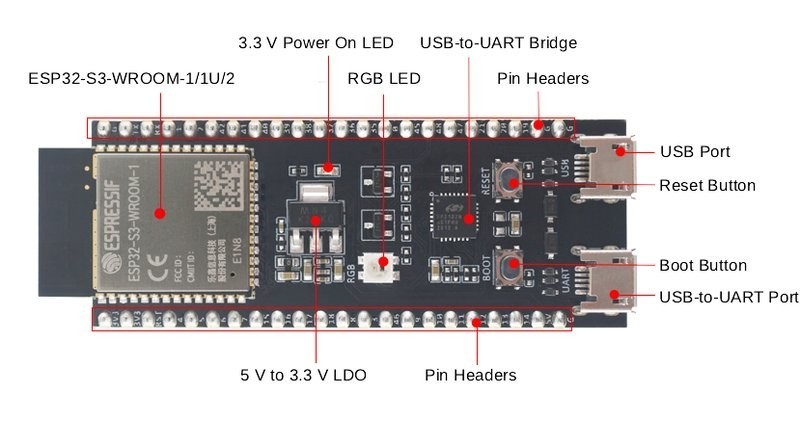
The ESP32-S3-DevKitC-1 is Espressif's most capable development board, pairing a dual-core Xtensa LX7 at 240MHz with 8MB PSRAM, 8MB flash, USB-OTG, and a DVP camera interface. It is the definitive choice for camera projects, edge AI, and any application requiring significant on-device memory.
Best for camera and AI projects, skip if you need WiFi 6, Thread, or ultra-low-power operation.
Where to Buy
Pros
- Dual-core Xtensa LX7 at 240MHz with vector instructions for AI/ML acceleration
- 8MB PSRAM enables on-device image processing and ML model inference
- DVP 8/16-bit camera interface for direct OV2640/OV5640 connection
- USB-OTG 1.1 for native HID, CDC, and mass storage without a bridge chip
- 7uA deep sleep current — competitive for a dual-core chip
Cons
- WiFi 4 (802.11 b/g/n) — lacks WiFi 6 support found on the ESP32-C6
- No Thread or Zigbee support — limited smart home protocol coverage
- 69mm length is larger than compact alternatives like the 21mm XIAO ESP32S3
Processing Power and AI Capabilities
The ESP32-S3 features a dual-core Xtensa LX7 running at 240MHz, a meaningful upgrade from the LX6 architecture in the original ESP32. The LX7 delivers approximately 20% higher instructions-per-clock, but the real differentiator is the addition of vector instructions specifically designed for neural network inference — SIMD operations that process multiple 8-bit or 16-bit values in a single cycle.
These vector extensions accelerate operations like multiply-accumulate that dominate ML workloads, providing 3-5x speedup over the original ESP32 for quantized INT8 inference. Combined with 8MB of PSRAM for model storage, the S3 can run small TensorFlow Lite models for tasks like keyword spotting (wake word detection at 95%+ accuracy with models under 200KB), simple image classification (MobileNet v1 at 5-10 FPS on 96x96 input), and gesture recognition via IMU data. Espressif's ESP-DL library provides pre-optimized operators for common layers. You will not run GPT-class models, but for edge inference at the sensor level, the S3 is the strongest option in the ESP32 family.
Thermal performance is well-behaved under sustained dual-core load. Running both cores at 240MHz with WiFi active and continuous PSRAM access, the chip stabilizes at 55-65°C without any heatsink, well within the 105°C junction limit. Unlike larger SoCs like the Rockchip RK3588S that require active cooling, the S3's 0.5W typical power consumption dissipates passively through the PCB ground plane.
Memory Architecture
The N8R8 variant on the DevKitC ships with 8MB of flash and 8MB of octal PSRAM. This is the highest memory configuration available in a standard Espressif dev kit. The PSRAM connects via an octal SPI interface, providing enough bandwidth for frame buffer operations.
With 512KB of internal SRAM plus 8MB of PSRAM, you can allocate large buffers for camera frames (a 320x240 RGB565 frame is 150KB), audio processing, or web server responses without running into the memory walls that constrain the original ESP32's 520KB SRAM. The flash storage is also double the original at 8MB, giving more room for firmware, OTA partitions, and SPIFFS/LittleFS file systems.
Camera and Display Interfaces
The DVP 8/16-bit camera interface is a hardware peripheral that connects directly to CMOS image sensors like the OV2640 (2MP) and OV5640 (5MP). This is a significant advantage over bit-banging or SPI-based camera solutions. The dedicated interface handles pixel clock synchronization, VSYNC/HSYNC timing, and DMA transfers.
On the display side, the S3 supports SPI, 8080 parallel, and RGB interfaces. This lets you drive TFT displays up to 480x320 (SPI) or 800x480 (RGB) without external display controllers. For projects combining a camera and display — like a video intercom or inspection camera — the S3 is the only ESP32 variant that handles both natively.
Connectivity
WiFi 802.11 b/g/n at 2.4GHz delivers 10-15 Mbps real-world throughput, and BLE 5.0 provides solid wireless coverage for most IoT scenarios. BLE 5.0 offers 2x the speed (2 Mbps vs 1 Mbps) and 4x the range of the BLE 4.2 in the original ESP32 when using Coded PHY (Long Range mode), extending indoor BLE range from 30-50m to 100+ meters. This makes the S3 viable for BLE-based location tracking and mesh sensor networks that previously required dedicated BLE 5.0 chips.
The notable absence is WiFi 6 and Thread/802.15.4 support. If you are building for the Matter smart home ecosystem over Thread, the ESP32-C6 (WiFi 6 + Thread) or ESP32-H2 (Thread + Zigbee) are the right choices. The S3 can run Matter over WiFi using Espressif's esp-matter SDK, but cannot participate in Thread mesh networks. For projects where WiFi connectivity is the primary wireless interface and BLE handles local device communication, the S3's radio combination is well-suited. ESPHome, WLED, and Tasmota all provide mature S3 support for smart home integrations over WiFi.
AI on the Edge: Vector Instructions and TFLite
The ESP32-S3's vector extension instructions are what separate it from every other chip in the ESP32 family for on-device machine learning. These SIMD (Single Instruction, Multiple Data) operations process multiple 8-bit or 16-bit integer values in a single clock cycle — precisely the data types used in quantized neural network models. When running INT8 quantized inference, the S3's vector unit delivers 3-5x throughput improvement over the original ESP32's LX6 core, which lacks these instructions entirely.
TensorFlow Lite Micro benchmarks on the S3 demonstrate practical edge AI capabilities within well-defined limits. Person detection using a MobileNet v1 model quantized to INT8 runs at 5-10 frames per second on 96x96 pixel grayscale input, consuming roughly 300KB of model weight storage in the 8MB PSRAM. Keyword spotting — the "Hey Siri" style wake-word detection — processes 16kHz audio in real time with models under 200KB, achieving 95%+ accuracy on trained wake words. Gesture recognition from IMU accelerometer data runs comfortably at inference times under 10ms per classification using models trained on 50-100 gesture samples.
The 8MB PSRAM is essential for these workloads. TFLite Micro allocates an arena buffer for intermediate tensor computations — typically 100KB-500KB depending on model architecture. Without PSRAM, the S3's 512KB internal SRAM must hold the firmware, WiFi stack (~60KB), model weights, input buffers, and tensor arena simultaneously, leaving insufficient room for anything beyond the simplest models. With 8MB PSRAM, model weights and tensor arenas live in external memory while the internal SRAM handles latency-sensitive WiFi and interrupt processing.
The honest comparison to dedicated AI accelerators puts the S3 in perspective. Google's Coral Edge TPU delivers 4 TOPS (trillion operations per second) and runs MobileNet v2 at 400+ FPS — roughly 50-80x faster than the S3 for image classification. NVIDIA's Jetson Orin Nano at 40 TOPS handles real-time object detection on 1080p video streams that the S3 cannot approach. But the S3 costs $8-12 versus $60+ for a Coral Dev Board or $200+ for a Jetson, needs no additional hardware or drivers, runs on 500mW versus 5-15W, and fits the AI model alongside WiFi connectivity, sensor reading, and actuator control on a single chip. For keyword spotting on a voice-controlled light switch, person detection on a battery-powered doorbell, or anomaly detection on vibration sensor data from a motor, the S3 handles the inference locally without cloud roundtrips, without a GPU, and without the complexity of a Linux-based SoC.
Common Gotchas
Some ESP32-S3-DevKitC clones from third-party sellers have incorrect eFuse configuration for PSRAM. The chip reports 0MB PSRAM even though the module has 8MB. This is a factory programming error, not a firmware issue. Buy from Espressif's official store or verified distributors (Mouser, DigiKey) to avoid this. If hit, the esptool.py eFuse commands can sometimes fix it, but it's risky.
The DevKitC has two USB-C ports (USB and UART) and beginners frequently plug into the wrong one. The USB port is for native USB (CDC, HID); the UART port is for serial programming. For Arduino IDE uploads, most users want the UART port. Label them with tape.
Pin strapping during boot is a common source of "my board won't flash" issues. GPIO0, GPIO3, GPIO45, and GPIO46 are strapping pins that determine boot mode. Connecting sensors or peripherals to these pins can prevent the board from entering download mode. Check Espressif's strapping pin documentation before wiring.
WiFi and Bluetooth 5.0 cannot transmit at full power simultaneously on the S3. If you need heavy WiFi throughput AND BLE scanning, expect degraded performance on one or both radios. The hardware shares the 2.4GHz radio frontend.
Full Specifications
Processor
| Specification | Value |
|---|---|
| Architecture | Xtensa LX7 [1] |
| CPU Cores | 2 [1] |
| Clock Speed | 240 MHz [1] |
| AI Acceleration | Vector instructions for AI/ML [1] |
Memory
| Specification | Value |
|---|---|
| Flash | 8 MB [1] |
| SRAM | 512 KB [1] |
| PSRAM | 8 MB [1] |
Connectivity
| Specification | Value |
|---|---|
| WiFi | 802.11 b/g/n [1] |
| Bluetooth | 5.0 [1] |
I/O & Interfaces
| Specification | Value |
|---|---|
| GPIO Pins | 45 [2] |
| ADC Channels | 20 [2] |
| SPI | 4 [2] |
| I2C | 2 [2] |
| UART | 3 [2] |
| USB | USB-OTG 1.1 + USB-UART [2] |
| Camera Interface | DVP 8/16-bit [2] |
| LCD Interface | SPI/8080/RGB [2] |
Power
| Specification | Value |
|---|---|
| Input Voltage | 5 V [1] |
| Deep Sleep Current | 7 uA [1] |
Physical
| Specification | Value |
|---|---|
| Dimensions | 69 x 25.4 mm [2] |
| Form Factor | Standard breadboard [2] |
Who Should Buy This
DVP camera interface connects directly to OV2640/OV5640 sensors. 8MB PSRAM buffers full frames for processing. Dual-core handles WiFi streaming on one core and image capture on the other.
Vector instructions accelerate keyword spotting models. 8MB PSRAM holds the audio buffer and model weights simultaneously. USB audio input is possible via OTG.
No 802.15.4 radio for Thread or Zigbee. The ESP32-C6 has WiFi 6 plus Thread support, or the ESP32-H2 for Thread/Zigbee-only.
Better alternative: ESP32-C6-DevKitC-1
7uA deep sleep is good but the ESP32-C3 at 5uA is better for multi-year battery life. The S3 is overkill if you only need periodic sensor reads.
Better alternative: ESP32-C3-DevKitM-1
USB-OTG 1.1 supports native HID without any bridge chip. Dual-core handles input polling on one core and USB communication on the other with zero latency.
At 69x25.4mm, the DevKitC is too large for wearables. The XIAO ESP32S3 uses the same chip in a 21x17.5mm package.
Better alternative: Seeed Studio XIAO ESP32S3
Ecosystem & Community
The ESP32-S3 runs on the largest microcontroller ecosystem in hobbyist electronics, with first-class support from Arduino IDE, ESPHome, WLED, Tasmota, MicroPython, and PlatformIO.
Compatible Software
What to Build First
Build a BME280 temperature/humidity/pressure sensor with an SSD1306 OLED display and a web dashboard served directly from the ESP32-S3. Reads environmental data every 30 seconds and displays it on a local web page accessible from any device on your network.
View tutorial →Must-Have Accessories
Video Reviews & Tutorials
Tutorials & Resources
- 35 ESP32 Guides and Sensor ProjectsComprehensive collection of ESP32 tutorials covering sensors, displays, web servers, and home automationtutorial
- 5 ESP32 Projects That Are Actually Worth BuildingCurated list of practical ESP32 projects with real-world utilityreview
Frequently Asked Questions
Can the ESP32-S3 run TensorFlow Lite?
Yes. The 8MB PSRAM and vector instructions make it capable of running small TFLite models for keyword spotting, simple image classification, and gesture recognition. Espressif provides ESP-DL libraries optimized for the S3's vector unit.
What camera modules work with the ESP32-S3-DevKitC?
The DVP 8/16-bit interface supports OV2640 (2MP), OV5640 (5MP), and similar CMOS sensors. You will need a breakout board or adapter cable to connect the sensor. The Seeed XIAO ESP32S3 Sense variant includes a built-in OV2640.
ESP32-S3 vs ESP32-C3: which should I choose?
Choose the S3 for camera, AI, or USB projects that need dual-core power and PSRAM. Choose the C3 for simple WiFi/BLE sensors where cost and power efficiency matter more. The C3 draws 5uA in deep sleep vs the S3's 7uA.
Does the ESP32-S3 support Matter?
The ESP32-S3 can run Matter over WiFi. For Thread-based Matter, you need the ESP32-C6 or ESP32-H2 which have 802.15.4 radios. Many Matter deployments use WiFi, so the S3 is compatible with a large portion of the ecosystem.
Why choose the DevKitC over the XIAO ESP32S3?
The DevKitC offers 45 accessible GPIO pins vs 11 on the XIAO, plus a full breadboard-compatible layout. Choose the XIAO when size matters (21x17.5mm vs 69x25.4mm) and you can work with fewer pins.
How much power does the ESP32-S3 use in deep sleep?
Approximately 7uA in deep sleep with RTC memory retained. This is competitive with other ESP32 variants and suitable for battery-powered applications with periodic wake cycles. The ESP32-C3 is slightly better at 5uA.
Can I use the ESP32-S3-DevKitC as a USB keyboard or mouse?
Yes. The USB-OTG 1.1 port supports native HID device mode. You can create keyboards, mice, game controllers, and MIDI devices without any external USB bridge chip. The TinyUSB library provides a clean API for this.
Compared In
ESP32-S3-DevKitC-1 appears in 26 buying guides on PAM Finds. These weigh it directly against the alternatives.
- Arduino Uno R4 WiFi vs ESP32-S3: Which Board Wins?
- ESP32-C6 vs ESP32-S3 for Matter Smart Home 2026
- ESP32-CAM vs ESP32-S3: Best Camera Board (2026)
- ESP32 vs S3 vs C3: Which Chip? (2026)
- ESP32-S3 Board Shootout: 5 Dev Boards Compared
- Microcontroller vs SBC: When to Use Which (2026)
- Pico 2 W vs ESP32-S3: Which WiFi MCU Wins?
- Teensy 4.1 vs ESP32-S3: Speed vs WiFi in 2026
18 more
- Best PCB Assembly Services for Small Batch Orders in 2026
- Best PCB Design Software for Beginners in 2026
- From Breadboard to Custom PCB: Complete Beginner Guide
- Design a Custom ESP32 Board in KiCad + Order from JLCPCB
- Design a Custom Meshtastic LoRa Node PCB
- ESP32 Module vs Bare Chip: When to Use Each
- ESP32-S3 Bluetooth Proxy for Home Assistant (2026)
- WiFi Temperature Sensor with ESP32 and ESPHome
- JLCPCB vs PCBWay vs OSH Park: Best PCB Service in 2026
- KiCad to JLCPCB: Generate Gerbers, BOM & CPL Files
- PCB Import Tariffs 2026: What US Makers Need to Know
- WLED Setup with ESP32-S3: Complete LED Strip Guide
- WLED Quickstart: ESP32 DevKitC LED Strip Setup
- DIY BLE Asset Tracker with XIAO ESP32-S3
- Best ESP32 Development Boards in 2026
- Best ESP32 for Home Assistant + ESPHome (2026)
- Best ESP32 Boards for WLED in 2026
- Best Microcontrollers for Audio Projects in 2026