ESP32-C6-DevKitC-1
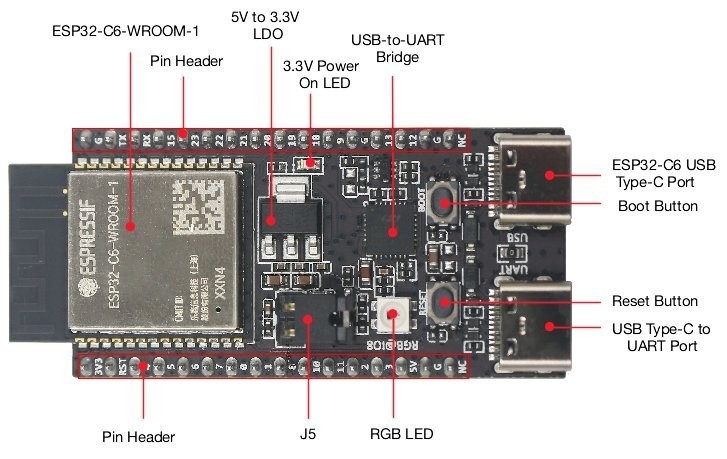
The ESP32-C6-DevKitC-1 is the ESP32 family's smart home powerhouse, combining WiFi 6 (802.11ax), BLE 5.3, Thread, Zigbee, and Matter support on a single-core RISC-V at 160MHz with a dedicated low-power co-processor. It is the only ESP32 board that bridges WiFi and 802.15.4 mesh networking protocols.
Best for Matter smart home devices, skip if you need dual-core processing or camera support.
Where to Buy
Pros
- WiFi 6 (802.11ax) delivers better range and efficiency than WiFi 4 on other ESP32 boards
- Thread and Zigbee via 802.15.4 radio enables mesh networking without a separate module
- BLE 5.3 with all latest features including periodic advertising and connection subrating
- Dedicated RISC-V low-power core at 20MHz handles light tasks while main core sleeps
- Full Matter support over both WiFi and Thread
Cons
- Single-core RISC-V at 160MHz — same processing limitation as the ESP32-C3
- No PSRAM — limits complex data processing applications
- Only 7 ADC channels for analog sensor input
WiFi 6 Advantage
The ESP32-C6 is the only ESP32 variant with WiFi 6 (802.11ax). WiFi 6 brings Target Wake Time (TWT), which allows the access point to schedule when the device wakes to check for data. This dramatically reduces power consumption in always-connected IoT devices compared to WiFi 4's constant polling — Espressif reports up to 60% power savings in TWT mode versus legacy power save on a WiFi 4 device performing the same communication pattern.
WiFi 6 also improves performance in dense networks through OFDMA (Orthogonal Frequency Division Multiple Access), which allows the access point to divide a single channel into sub-channels for simultaneous communication with multiple devices. If you are deploying dozens of IoT devices on a single access point, OFDMA reduces collision and latency from 15-30ms per device contention down to 2-5ms scheduled slots. For a smart home with 20-50 connected devices, this makes a measurable difference in network reliability and responsiveness.
The practical WiFi 6 throughput on the C6 peaks at approximately 20 Mbps — faster than WiFi 4 boards in the same family, though still far below what WiFi 6 achieves on laptops and phones with wider channel widths. For IoT payloads (MQTT packets, sensor readings, OTA updates), this bandwidth is more than sufficient. The real benefit is latency and power, not raw throughput.
Thread, Zigbee, and Matter
The 802.15.4 radio on the C6 enables Thread 1.3 and Zigbee 3.0 protocols natively, making it the bridge between WiFi and mesh networking in a single chip. Thread is the transport layer for the Matter smart home standard, which Google, Apple, Amazon, and Samsung all support as of 2024. Matter over Thread eliminates the need for proprietary hubs — your Thread devices communicate through border routers built into Apple HomePod Mini, Google Nest Hub, and Amazon Echo (4th gen).
The unique value of the C6 is its dual-radio capability: WiFi 6 for cloud connectivity and 802.15.4 for mesh networking on the same die. This makes it uniquely suited as a Thread border router — a device that connects your Thread mesh network to your WiFi network and ultimately the internet. Espressif provides a reference border router implementation in ESP-IDF that routes between Thread and WiFi with automatic prefix delegation. The ESP32-H2 supports Thread and Zigbee but has no WiFi, requiring a separate gateway device.
Zigbee 3.0 support means direct compatibility with existing Zigbee networks without middleware. You can build devices that work with Philips Hue, SmartThings, IKEA Dirigera, or any Zigbee coordinator. The certified Zigbee stack from Espressif handles device profiles for lights, switches, sensors, and thermostats. Combined with the WiFi radio providing internet backhaul, the C6 can simultaneously coordinate a Zigbee network while exposing it to cloud services — a capability that previously required separate hardware.
Low-Power Architecture
The C6 includes a dedicated RISC-V low-power core running at 20MHz alongside the main RISC-V core at 160MHz. This LP core can monitor GPIO pins, run simple state machines, manage BLE advertising, or handle ULP (Ultra Low Power) coprocessor tasks while the main core remains in deep sleep at 7uA. The LP core draws approximately 100-200uA during active operation — orders of magnitude less than waking the main core for the same tasks.
For smart home devices that need to be responsive to button presses or BLE connections while spending most of their time idle, the LP core provides a middle ground between full operation and deep sleep. A Thread sleepy end device can use the LP core to periodically poll its Thread parent, wake the main core only when a message is received, and return to deep sleep. This pattern extends battery life from days to months on a single charge.
The main RISC-V core at 160MHz matches the ESP32-C3's performance profile — adequate for IoT workloads but not suited for compute-heavy applications. With 512KB SRAM and no PSRAM, the C6 targets the same lightweight sensor and actuator applications as the C3. The 7uA deep sleep is slightly higher than the C3's 5uA, but the LP core more than compensates in scenarios requiring periodic wake-without-full-boot cycles. For projects where the device must respond to external events within milliseconds rather than the 200-300ms boot time from deep sleep, the LP core is the enabling feature.
WiFi 6 and Thread: The C6's Dual Protocol Advantage
The ESP32-C6 is the only ESP32 variant that simultaneously operates WiFi 6 (802.11ax) and an 802.15.4 radio for Thread and Zigbee mesh networking. This dual-protocol capability on a single chip is what makes the C6 uniquely suited for smart home bridging — no other Espressif product combines both radios. The ESP32-C5, announced as the next-generation WiFi chip, adds 5GHz band support and WiFi 6 on dual-band (2.4GHz + 5GHz) but drops the 802.15.4 radio entirely. If your project needs Thread or Zigbee, the C6 remains the only option in the ESP32 family.
WiFi 6's 802.11ax protocol delivers meaningful improvements over the WiFi 4 (802.11n) found on the ESP32, ESP32-S2, ESP32-S3, and ESP32-C3. Target Wake Time (TWT) lets the access point schedule when each device wakes to transmit, reducing idle power by up to 60% compared to legacy power save modes. OFDMA subdivides each channel into resource units that serve multiple devices simultaneously, cutting per-device latency from 15-30ms contention windows down to 2-5ms scheduled slots. In a dense smart home with 30-50 connected devices sharing one access point, these improvements translate to noticeably faster response times and longer battery life.
The 802.15.4 radio enables Thread 1.3 mesh networking — the transport layer underneath the Matter smart home standard backed by Apple, Google, Amazon, and Samsung. Thread devices form self-healing mesh networks where each powered node can route traffic for battery-operated sleepy end devices. The C6 can run both protocols concurrently: WiFi 6 maintains the cloud connection to Home Assistant, Google Home, or Apple HomeKit, while the 802.15.4 radio manages a local Thread mesh of sensors and switches. This makes the C6 a natural Thread border router — bridging the mesh to the internet — without requiring separate WiFi and Thread hardware. Espressif's ESP-IDF includes a reference border router implementation with automatic IPv6 prefix delegation, reducing the software effort to a configuration exercise rather than a protocol engineering project.
Common Gotchas
Thread/Matter is supported in hardware but the software ecosystem is still maturing. ESP-IDF has Thread support but the Arduino-ESP32 core's Thread support is experimental. If you're building a Thread device with Arduino IDE, expect gaps in documentation and library support. ESP-IDF is the recommended path for Thread projects.
WiFi 6 (802.11ax) requires a WiFi 6 router to get any benefit. On a WiFi 5 (802.11ac) or older router, the C6 operates as a WiFi 4 (802.11n) device — same as every other ESP32. Don't buy the C6 specifically for WiFi 6 unless your router supports it.
The C6 is single-core RISC-V at 160MHz. Projects that worked on the dual-core S3 at 240MHz may run slower or fail to keep up with timing-critical tasks. Display rendering + WiFi on a single core causes visible stutter. For display + network projects, the S3 is still the better choice.
4MB flash on the base DevKitC model fills up fast with OTA partitions. A typical Arduino project with WiFi, OTA, and SPIFFS needs about 3.2MB, leaving barely 800KB for application data. Choose the 8MB flash variant if you need OTA updates.
Full Specifications
Processor
| Specification | Value |
|---|---|
| Architecture | RISC-V [1] |
| CPU Cores | 1 [1] |
| Clock Speed | 160 MHz [1] |
| Low-Power Core | RISC-V LP core @ 20MHz [1] |
Memory
| Specification | Value |
|---|---|
| Flash | 8 MB [1] |
| SRAM | 512 KB [1] |
Connectivity
| Specification | Value |
|---|---|
| WiFi | 802.11ax (WiFi 6) [1] |
| Bluetooth | 5.3 [1] |
| Thread | Yes [1] |
| Zigbee | 3.0 [1] |
| Matter | Yes [1] |
I/O & Interfaces
| Specification | Value |
|---|---|
| GPIO Pins | 30 [2] |
| ADC Channels | 7 [2] |
| SPI | 1 [2] |
| I2C | 2 [2] |
| UART | 3 [2] |
| USB | USB 2.0 (CDC) [2] |
Power
| Specification | Value |
|---|---|
| Input Voltage | 5 V [1] |
| Deep Sleep Current | 7 uA [1] |
Physical
| Specification | Value |
|---|---|
| Dimensions | 67 x 25.4 mm [2] |
| Form Factor | Standard breadboard [2] |
Who Should Buy This
Full Matter support over both WiFi and Thread. The 802.15.4 radio enables Thread mesh networking for reliable, low-power smart home communication. BLE 5.3 handles device provisioning.
Native Zigbee 3.0 support via the 802.15.4 radio. WiFi 6 provides the backhaul to your home network. No external Zigbee module needed.
The C6 is the only ESP32 with both WiFi and Thread radios, making it uniquely suited as a Thread border router that bridges Thread mesh to your WiFi network.
Single-core at 160MHz, no PSRAM, no camera interface. The ESP32-S3 with dual-core, 8MB PSRAM, and DVP camera is designed for this.
Better alternative: ESP32-S3-DevKitC-1
The C6 works but includes a WiFi radio you won't use. The ESP32-H2 is Thread/Zigbee-only at lower power if you truly don't need WiFi.
Better alternative: ESP32-H2-DevKitM-1
Ecosystem & Community
The ESP32-C6 is the primary Matter/Thread development target in the ESP32 family with growing ESPHome and Home Assistant integration support.
Compatible Software
What to Build First
Configure the ESP32-C6 as a Thread border router that bridges your Thread mesh network to WiFi, enabling Matter devices to communicate with Home Assistant without a commercial hub. The only ESP32 with both WiFi and 802.15.4 radios.
View tutorial →Must-Have Accessories
Video Reviews & Tutorials

Tutorials & Resources
- ESP-IDF Thread Programming GuideOfficial Thread implementation guide for the ESP32-C6 including border router configurationdocs
- ESP32-C6 with ESPHome and Home AssistantESPHome integration guide for the C6 platform including Thread and WiFi 6 configurationtutorial
- connectedhomeip (Matter SDK)The open-source Matter SDK — ESP32-C6 is a primary development target for Matter over Threadgithub
Frequently Asked Questions
What is the advantage of WiFi 6 on the ESP32-C6?
WiFi 6 (802.11ax) provides Target Wake Time for scheduled wake cycles (reducing power), OFDMA for better performance in dense device networks, and improved range. For IoT deployments with many devices on one access point, WiFi 6 reduces collision and latency.
Can the ESP32-C6 be a Thread border router?
Yes. The C6 is uniquely positioned for this role because it has both WiFi and 802.15.4 radios. It can bridge your Thread mesh network to your WiFi network, acting as the gateway between local mesh devices and the internet.
ESP32-C6 vs ESP32-H2: which for smart home?
The C6 if you need WiFi connectivity (most smart home hubs need internet access). The H2 if you are building a Thread/Zigbee-only end device (like a sensor or switch) that communicates via a separate border router.
Does the ESP32-C6 support Apple HomeKit?
The ESP32-C6 supports Matter, which is compatible with Apple Home, Google Home, Amazon Alexa, and Samsung SmartThings. Direct HomeKit Accessory Protocol (HAP) is also possible but less common now that Matter is widely adopted.
Can I use Zigbee and WiFi simultaneously on the ESP32-C6?
Yes. The 802.15.4 radio (Zigbee/Thread) and the WiFi radio operate independently with automatic coexistence management. You can run a Zigbee coordinator while maintaining a WiFi connection for cloud communication.
Compared In
ESP32-C6-DevKitC-1 appears in 21 buying guides on PAM Finds. These weigh it directly against the alternatives.
- ESP32-C3 vs ESP32-C6: Which RISC-V Board for Battery IoT?
- ESP32-C5 vs ESP32-C6: Dual-Band or Single-Band WiFi 6?
- ESP32-C6 vs ESP32-S3 for Matter Smart Home 2026
- ESP32-C6 vs ESP32-H2: WiFi 6, Thread, and Zigbee Compared
- Best PCB Assembly Services for Small Batch Orders in 2026
- Best PCB Design Software for Beginners in 2026
- From Breadboard to Custom PCB: Complete Beginner Guide
- Design a Custom ESP32 Board in KiCad + Order from JLCPCB
13 more
- Design a Custom ESPHome Sensor Board: Idea to Production
- Design a Custom Meshtastic LoRa Node PCB
- Battery-Powered Soil Sensor with ESP32-C6 and ESPHome
- ESP32-C6 as a Thread Border Router for Home Assistant
- ESP32 Module vs Bare Chip: When to Use Each
- WiFi Temperature Sensor with ESP32 and ESPHome
- HA Green vs Yellow vs DIY Pi 5: Which to Buy?
- JLCPCB vs PCBWay vs OSH Park: Best PCB Service in 2026
- KiCad to JLCPCB: Generate Gerbers, BOM & CPL Files
- PCB Import Tariffs 2026: What US Makers Need to Know
- Best Budget ESP32 Boards Under $15 in 2026
- Best ESP32 Development Boards in 2026
- Best ESP32 for Home Assistant + ESPHome (2026)