ESP32-C3-DevKitM-1
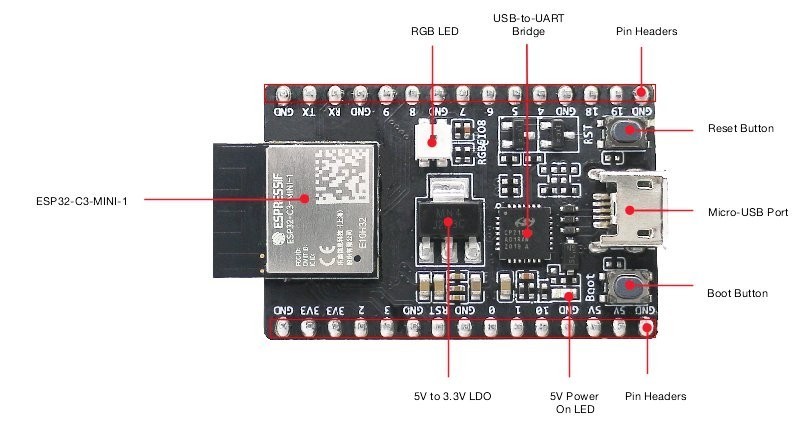
The ESP32-C3-DevKitM-1 is the most cost-effective board in the ESP32 lineup, combining a single-core RISC-V processor at 160MHz with WiFi and BLE 5.0 in a compact package. At roughly seven dollars, it delivers modern wireless connectivity with the lowest deep sleep current of any ESP32 variant at 5uA.
Best budget ESP32 for simple WiFi/BLE sensors, skip if you need dual-core performance or camera support.
Where to Buy
Pros
- 5uA deep sleep current — lowest in the ESP32 family for maximum battery life
- BLE 5.0 with Long Range (Coded PHY) support for extended wireless reach
- RISC-V architecture is open-standard and increasingly well-supported
- USB 2.0 CDC for programming without a separate UART bridge chip
Cons
- Single-core RISC-V at 160MHz — noticeably slower than dual-core Xtensa LX7 boards
- No PSRAM — limits buffer sizes for complex data processing
- Only 22 GPIO pins — restricting for projects with many peripherals
- 6 ADC channels versus 18-20 on larger ESP32 boards
RISC-V Architecture
The ESP32-C3 is Espressif's first RISC-V chip, using a single 32-bit core clocked at 160MHz. The RISC-V ISA is open-standard, which means growing toolchain support from GCC, LLVM, and Rust. For developers invested in the RISC-V ecosystem, the C3 is the most practical entry point with WiFi and BLE connectivity. The esp-rs community maintains production-quality Rust HAL crates for the C3, and the compiler's RISC-V target is significantly more mature than Xtensa support.
The single-core limitation is real but manageable. The WiFi and BLE stacks are well-optimized for single-core operation, and for typical IoT workloads — read sensor, format data, transmit, sleep — the 160MHz RISC-V core is more than sufficient. Benchmark comparisons show the C3 achieving roughly 65-70% of the original dual-core ESP32's throughput in multi-tasking scenarios, but matching or exceeding it for single-threaded integer workloads thanks to the cleaner RISC-V pipeline. You will feel the constraint if you try to run a web server while simultaneously processing sensor data or streaming audio.
The 400KB SRAM (with roughly 200-250KB available after the WiFi/BLE stack initializes) handles most sensor firmware comfortably. No PSRAM option means you cannot buffer large data structures, but for the C3's target workload of read-transmit-sleep, this is rarely a bottleneck. The 4MB flash supports standard dual-OTA partition schemes with approximately 1.5MB per application slot.
Power Efficiency
The C3's 5uA deep sleep current is the standout spec and the primary reason to choose this board over any other ESP32 variant for battery-powered applications. For context, a CR2032 coin cell battery has approximately 225mAh of capacity. At 5uA continuous draw in deep sleep, the C3 could theoretically last over 5 years on a single coin cell — though real-world duty cycles with periodic WiFi transmissions will reduce this significantly.
In a realistic ESPHome deep sleep configuration — waking every 15 minutes, connecting to WiFi (1-3 seconds at 160-240mA), transmitting an MQTT packet (50-100ms at 120mA), then returning to sleep — average current consumption works out to approximately 0.3-0.5mA. A 2000mAh LiPo battery sustains this for 6-12 months depending on WiFi signal strength and connection time. Adding a small 1W solar panel with a TP4056 charger makes the node self-sustaining indefinitely.
Compared to the ESP32-S3 at 7uA and the original ESP32 at 10uA, the C3's power efficiency gives it a clear edge in battery-powered deployments. The difference compounds: over 1 year of deep sleep, the C3 consumes 44mAh versus the original ESP32's 88mAh — nearly double. If your project runs on a battery and wakes periodically to transmit data, the C3 should be your default choice. The ESP32-C6 at 7uA deep sleep draws 40% more but adds WiFi 6's Target Wake Time for further power savings during active communication.
Connectivity
WiFi 802.11 b/g/n and BLE 5.0 is a modern wireless combination that covers the vast majority of IoT use cases. Real-world WiFi throughput averages 8-12 Mbps with the integrated PCB antenna — more than enough for telemetry, REST APIs, and OTA firmware updates. The BLE 5.0 upgrade from the original ESP32's BLE 4.2 is meaningful: 2x data throughput (2 Mbps vs 1 Mbps), 4x range with Coded PHY extending indoor range from 30-50m to 100+ meters, and support for BLE mesh networking with up to 32,000 nodes.
The USB 2.0 CDC interface deserves mention — it provides a serial connection for programming and debugging without a separate UART bridge chip. While it does not support USB-OTG like the ESP32-S3, it simplifies the board design and allows programming via a standard USB-C cable. Arduino IDE, PlatformIO, and ESP-IDF all support flashing via this native USB serial interface.
The absence of Thread (802.15.4) and WiFi 6 is notable. For new smart home installations targeting the Matter protocol over Thread, the ESP32-C6 is the better choice with its dual-radio design. But for standard WiFi + BLE sensor networks, home automation with ESPHome, or simple MQTT-based data collection, the C3 covers all the bases at a lower price point and power draw than any other ESP32 variant.
Single-Core RISC-V: Strengths and Limitations
The ESP32-C3's single RISC-V core at 160MHz invites direct comparison with the ESP32-S3's dual Xtensa LX7 cores at 240MHz. On paper, the S3 has roughly 3x the raw processing budget (two cores at 50% higher clock speed). In practice, the gap depends entirely on the workload pattern — and for the C3's target use case of simple IoT sensors, the single core is not just adequate but preferable.
For straightforward sensor-to-cloud pipelines — read an I2C sensor, format a JSON payload, publish to MQTT, enter deep sleep — the C3 completes the entire wake-transmit-sleep cycle in 1.5-3 seconds depending on WiFi connection time. The single core handles the WiFi stack and application logic sequentially, which is fine because these operations are inherently sequential: you cannot transmit data you have not yet read. The 160MHz RISC-V core executes integer operations at comparable speed to a single Xtensa LX7 core thanks to the clean RISC-V pipeline, and sensor reads over I2C (typically 100-400kHz bus speed) are I/O-bound regardless of CPU speed.
The single-core limitation becomes apparent in concurrent workloads. Driving an SPI display while maintaining a WiFi connection causes visible frame stuttering because the WiFi stack interrupts display refresh. Running a web server with multiple concurrent HTTP clients degrades response times as each request competes for the same core — the S3 handles web serving on one core while the other processes application logic. Audio streaming via I2S suffers from buffer underruns when WiFi transmissions spike CPU usage. Camera interfaces are entirely impractical: the C3 lacks the DVP/MIPI camera interface hardware, and even if it had one, the single core cannot simultaneously capture frames and process or transmit them.
The power consumption advantage is the single core's real justification. With one core and a lower clock speed, the C3 draws approximately 15mA in modem-sleep mode (WiFi connected, CPU idle) versus the S3's 30-40mA in the same state. The 5uA deep sleep current — lowest in the ESP32 family — compounds this advantage. For a sensor node that spends 99.9% of its time sleeping and 0.1% actively transmitting, the C3's lower active and sleep current translates to measurably longer battery life. At roughly $3-4 for the bare ESP32-C3 module (versus $5-6 for the S3), the C3 also wins on BOM cost for production deployments of hundreds of simple sensor nodes where dual-core performance is wasted.
Full Specifications
Processor
| Specification | Value |
|---|---|
| Architecture | RISC-V [1] |
| CPU Cores | 1 [1] |
| Clock Speed | 160 MHz [1] |
Memory
| Specification | Value |
|---|---|
| Flash | 4 MB [1] |
| SRAM | 400 KB [1] |
Connectivity
| Specification | Value |
|---|---|
| WiFi | 802.11 b/g/n [1] |
| Bluetooth | 5.0 [1] |
I/O & Interfaces
| Specification | Value |
|---|---|
| GPIO Pins | 22 [2] |
| ADC Channels | 6 [2] |
| SPI | 3 [2] |
| I2C | 1 [2] |
| UART | 2 [2] |
| USB | USB 2.0 (CDC) [2] |
Power
| Specification | Value |
|---|---|
| Input Voltage | 5 V [1] |
| Deep Sleep Current | 5 uA [1] |
Physical
| Specification | Value |
|---|---|
| Dimensions | 53.6 x 25.4 mm [2] |
| Form Factor | Standard breadboard [2] |
Who Should Buy This
5uA deep sleep is the lowest in the ESP32 family. Wake every 15 minutes, read a sensor, transmit via WiFi or BLE, go back to sleep. A 2000mAh battery lasts years at this duty cycle.
BLE 5.0 with Coded PHY extends range to 400m+ line-of-sight. Low power draw makes it viable for coin-cell-powered beacons.
Single core at 160MHz and no PSRAM make video processing impossible. The ESP32-S3 with 8MB PSRAM and camera interface is designed for this.
Better alternative: ESP32-S3-DevKitC-1
Only 6 ADC channels and 22 GPIO pins. The original ESP32-DevKitC has 18 ADC channels and 34 GPIO pins.
Better alternative: ESP32-DevKitC V4
Supports Matter over WiFi, but lacks Thread for mesh networking. The ESP32-C6 adds WiFi 6 and Thread for full Matter support.
Better alternative: ESP32-C6-DevKitC-1
Ecosystem & Community
The ESP32-C3 shares the full arduino-esp32 ecosystem and is the best-supported RISC-V target for Rust embedded development via esp-rs.
Compatible Software
What to Build First
Build a sensor that wakes every 15 minutes, reads a BME280, sends data to Home Assistant via MQTT, and returns to 5uA deep sleep. Demonstrates the C3's power efficiency advantage for multi-year battery life.
View tutorial →Must-Have Accessories
Video Reviews & Tutorials

Tutorials & Resources
- ESPHome Deep Sleep ConfigurationOfficial guide to configuring deep sleep wake intervals and wake sources for battery-powered sensorstutorial
- ESP32-C3 Technical Reference ManualComplete hardware reference covering all peripherals, power modes, and register mapsdocs
- esp-rs/esp-hal (Rust HAL)Hardware abstraction layer for Rust on ESP32-C3 — the primary entry point for Rust embedded on RISC-V ESP32github
Frequently Asked Questions
Is the ESP32-C3 fast enough for a web server?
Yes, for simple REST APIs and small web pages. The single core at 160MHz handles HTTP requests adequately. For complex web applications with concurrent connections, the dual-core ESP32-S3 at 240MHz is a better fit.
Can the ESP32-C3 run Arduino code?
Yes. Arduino IDE and PlatformIO both support the ESP32-C3 with the ESP32 Arduino Core. Most Arduino libraries written for ESP32 work without modification, though some that use Xtensa-specific assembly will need RISC-V alternatives.
ESP32-C3 vs ESP32-C6: what is the difference?
The C6 adds WiFi 6 (802.11ax), BLE 5.3, Thread, Zigbee, and a low-power RISC-V co-processor. The C3 has WiFi 4 and BLE 5.0 only. Choose the C6 for smart home/Matter projects; choose the C3 for budget sensors.
Does the ESP32-C3 support Rust?
Yes. Espressif actively maintains Rust support for RISC-V ESP32 chips including the C3. The esp-rs project provides HAL crates, and the RISC-V target is well-supported by the Rust compiler.
How long does an ESP32-C3 last on a battery?
At 5uA deep sleep current, a 2000mAh LiPo battery lasts over 45 years in sleep alone. Real-world battery life depends on wake frequency and WiFi transmission duration. Waking every 15 minutes to send a BLE packet, expect 1-2 years on a CR2032.
Compared In
ESP32-C3-DevKitM-1 appears in 19 buying guides on PAM Finds. These weigh it directly against the alternatives.
- ESP32-C3 vs ESP32-C6: Which RISC-V Board for Battery IoT?
- ESP32 vs S3 vs C3: Which Chip? (2026)
- ESP32 vs Raspberry Pi Pico 2026: Which Should You Buy?
- Microcontroller vs SBC: When to Use Which (2026)
- Best PCB Assembly Services for Small Batch Orders in 2026
- From Breadboard to Custom PCB: Complete Beginner Guide
- Design a Custom ESPHome Sensor Board: Idea to Production
- Design a Custom Meshtastic LoRa Node PCB
11 more
- Battery-Powered Soil Sensor with ESP32-C6 and ESPHome
- ESP32-C6 as a Thread Border Router for Home Assistant
- ESP32 Module vs Bare Chip: When to Use Each
- ESP32-S3 Bluetooth Proxy for Home Assistant (2026)
- WiFi Temperature Sensor with ESP32 and ESPHome
- JLCPCB vs PCBWay vs OSH Park: Best PCB Service in 2026
- KiCad to JLCPCB: Generate Gerbers, BOM & CPL Files
- Best Budget ESP32 Boards Under $15 in 2026
- Best ESP32 Development Boards in 2026
- Best ESP32 for Home Assistant + ESPHome (2026)
- Best ESP32 Boards for WLED in 2026