LILYGO T-Beam Supreme
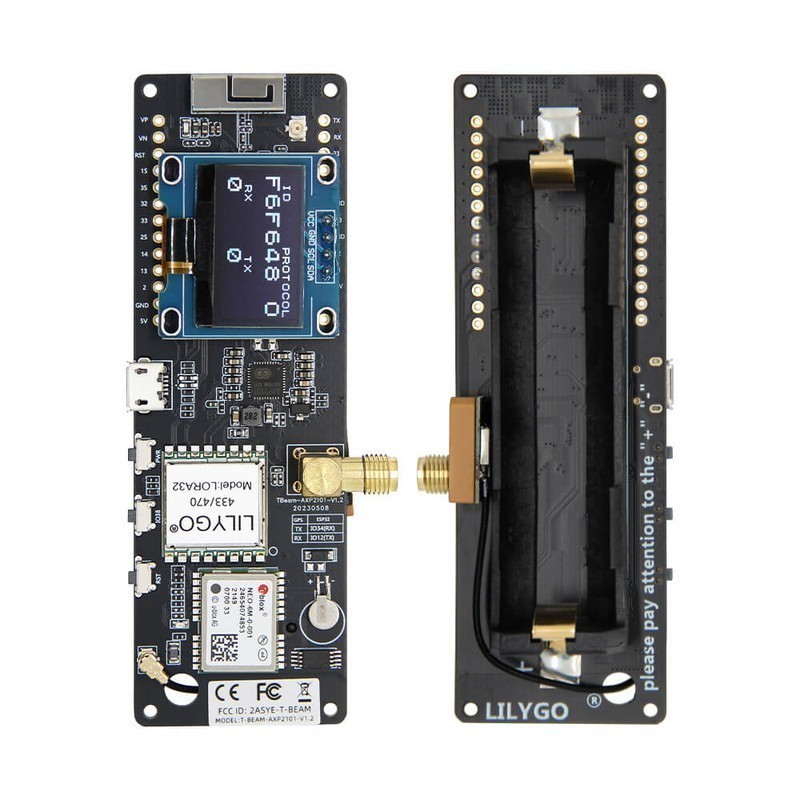
The LILYGO T-Beam Supreme is Node 2 in our disaster-comms guide: ESP32-S3, SX1262, L76K GNSS, 1.3-inch SH1106 OLED, 18650 cage, 114 x 33 x 28 mm. Cold start 30–60 s outdoors. Skip USB-only home bases (Heltec V3). No dedicated solar JST — AXP2101 charges over USB-C at 3.9–6 V.
Best GNSS + 18650 Meshtastic go-bag node — skip if you only need a USB-powered stationary base.
Where to Buy
Pros
- L76K GNSS plus 18650 cage on one board — the go-bag node the disaster-comms guide assumes
- 1.3-inch SH1106 OLED (not a 0.96-inch SSD1306) for position and node count in the field
- SX1262 LoRa with 8 MB PSRAM for a larger node database than the original T-Beam
- Unprotected flat-top 18650 cells swap in seconds; button-top protected cells often do not seat
- Pairs with a Heltec V3 USB-C base instead of replacing it
Cons
- 114 x 33 x 28 mm — pocketable as a bar, not as a card like the T1000-E
- Antenna jack is U.FL, not SMA; we need a pigtail before a whip
- No dedicated solar JST — AXP2101 charges from USB-C at 3.9–6 V only
- GNSS cold start 30–60 s outdoors; indoors it may never lock
- About 12 GPIO remain after LoRa, GNSS, OLED, and the SD slot
Node 2: GNSS and 18650, not a second V3
The disaster-comms guide assumes this board in the bag and a Heltec V3 on USB-C at home. We do not skip the V3 because we bought a T-Beam. GNSS and the 18650 cage are the reason this exists. If we only need a plugged-in relay, we are on the wrong page.
Display is a 1.3-inch SH1106, 128x64 — not the Heltec's 0.96-inch SSD1306. The PCB is a 114 x 33 x 28 mm bar, not a 100 x 32 mm stick. Measure the printed case before we copy an old T-Beam STL. Reviews that still say 0.96-inch SSD1306 are describing a different revision.
Building the same kit from a V3 means an external GNSS module, a holder, and more joints to fail at 2am. The Supreme puts L76K, the cage, and SX1262 on one bar. That is the point. It is not a reason to skip the V3 base. We still flash both.
GNSS performance and location sharing
L76K cold start is 30–60 s outdoors with sky. Indoors it may never fix — that is the module, not a brick. Warm starts drop to a few seconds once the almanac is cached. Accuracy is typically a couple of meters CEP with a clear view, enough to know which trail, not which footstep.
GNSS is why Node 2 exists. Position lets the mesh compute distance and bearing, broadcast a fix on a timer, and draw last-known dots in the phone app. Search, group hikes, or finding a relay we parked last month all need that. Text-only mesh is the V3's job on the shelf.
Power around the L76K matters. Active tracking is tens of milliamps. Meshtastic can duty-cycle a fix every 5, 15, or 30 minutes. At 15 minutes the average add is small. For a parked repeater whose coordinates never change, disable GNSS in firmware and keep the stored point. Do not declare the module dead after an indoor test.
LoRa range, U.FL, and charging
The SX1262 still follows antenna and height. The larger ground plane helps; it does not cancel a stub in a pocket. Line-of-sight claims in the 10–15 km class are antenna-and-elevation experiments. Urban pocket-to-pocket is much shorter. Mount height beats a second radio.
The LoRa jack is U.FL, not SMA. Reviews that say we can finger-tighten an SMA onto this board are describing a different revision. Use a pigtail, then a tuned 915 MHz antenna. U.FL hates repeated mates. Do not treat an SMA-direct how-to as this Supreme.
There is no dedicated solar JST on the Supreme. Power management is AXP2101. Input is USB-C at about 3.9–6 V. A 5 V panel or power bank on USB-C is the solar path, not a 6 V barrel into a mystery solar pad from an older T-Beam drawing. The holder wants an unprotected flat-top 18650. Protected button-top cells often sit high and drop out on a bounce. A foam scrap over the cell is a common field fix. Do not assume a random protected cell will lock in.
ESP32-S3 under the hood
The Supreme uses an ESP32-S3, dual-core Xtensa LX7 at 240 MHz, 8 MB PSRAM, 8 MB flash. The S3 vector path helps Meshtastic's AES work versus the original T-Beam's older ESP32. The 8 MB PSRAM is the node-database headroom: past a few dozen heard nodes, positions and routing tables need that extra RAM.
WiFi and BLE 5.0 sit beside LoRa. WiFi brings the Meshtastic web UI — join the board AP from a laptop to set channels and look at the map. BLE is how the phone app stays attached for typing on a real screen instead of the SH1106. The 1.3-inch panel is still 128x64; it is larger glass than the V3, not a new resolution.
About 12 GPIO remain after LoRa SPI, GNSS UART, OLED I2C, battery ADC, and the MicroSD slot. A BME280 or a relay still fits. A sensor farm does not. Use a spare ESP32 for that and let this bar stay the radio.
We do not call this a drop-in for the stale wio-tracker-1110 listing — that id is gone. For a thin card tracker, the SenseCAP T1000-E is the current card. For a USB base, Heltec V3. For this bar, GNSS plus 18650.
Common gotchas
GNSS cold start takes 30–60 s outdoors with sky. Indoors the L76K may never lock. That is expected. Take it outside before we declare the module dead. Warm starts drop once the almanac is cached.
The 18650 cage wants an unprotected flat-top cell. Protected button-tops often fail to seat. The spring can lose contact on a bounce — foam over the cell is the field fix. Do not solder tabs unless we are ready to own that pack permanently.
The antenna jack is U.FL, not SMA. SMA-direct reviews and sacrificial SMA adapters belong to a different board. Add a pigtail, then a whip. U.FL mating life is short; seat once.
There is no dedicated solar JST. Do not follow older T-Beam solar-pad diagrams. AXP2101 charges from USB-C at 3.9–6 V. A 5 V USB panel is the outdoor path.
Web-flasher updates can leave a boot loop. Hold BOOT, power-cycle, reflash over USB. Keep a known-good binary on the laptop we actually carry.
Full Specifications
Processor
| Specification | Value |
|---|---|
| Architecture | Xtensa LX7 [1] |
| CPU Cores | 2 [1] |
| Clock Speed | 240 MHz [1] |
Memory
| Specification | Value |
|---|---|
| Flash | 8 MB [1] |
| SRAM | 512 KB [1] |
| PSRAM | 8 MB [1] |
Connectivity
| Specification | Value |
|---|---|
| WiFi | 802.11 b/g/n [1] |
| Bluetooth | 5.0 [1] |
| lora | SX1262 (868/915MHz) [1] |
| lora_range | Up to 15km line-of-sight [1] |
| meshtastic | Fully supported (recommended device) [1] |
I/O & Interfaces
| Specification | Value |
|---|---|
| gps | L76K GNSS (GPS/GLONASS/BeiDou) [2] |
| Display | 1.3" OLED (128x64) [2] |
| GPIO Pins | 12 [2] |
| SPI | 1 [2] |
| I2C | 1 [2] |
| USB | USB-C [2] |
| SD Card | MicroSD slot [2] |
Power
| Specification | Value |
|---|---|
| Input Voltage | 5 V [1] |
| Battery Charging | 18650 battery holder + USB-C charging [1] |
| solar_charging | Solar panel input [1] |
| Deep Sleep Current | ~10 uA [1] |
Physical
| Specification | Value |
|---|---|
| Dimensions | 100 x 32 mm [2] |
| Form Factor | Long bar (with 18650 battery holder) [2] |
Who Should Buy This
L76K coordinates and an 18650 cage are why this is Node 2. Skip if the only node we will own lives on a USB brick at home.
GNSS and 18650 are wasted on a shelf with wall power. Heltec V3 is Node 1 for that.
Better alternative: Heltec WiFi LoRa 32 V3
This board can sit outdoors on USB-C 5 V solar, but it is not the sub-30 µA RAK WisBlock Node 3 we spec for a hilltop box. There is no dedicated solar JST.
Better alternative: RAK WisBlock Meshtastic Starter Kit
Carry coordinates and a swappable 18650. Keep a Heltec V3 on USB-C at home so the bag node has a peer. One T-Beam alone is still a paperweight without another radio in range.
L76K plus LoRa works inside a few kilometers of a base node. Beyond that campus or ranch, a cellular tracker is the honest tool. Duty-cycle GNSS or the 18650 dies in a weekend.
Ecosystem & Community
T-Beam Supreme is the GNSS + 18650 go-bag in our disaster-comms pair. Heltec V3 stays the USB-C base. Meshtastic firmware is the supported load.
Compatible Software
What to Build First
Flash Meshtastic, fit an unprotected flat-top 18650, add a U.FL pigtail and tuned 915 MHz antenna. This is the GNSS go-bag our disaster-comms guide assumes next to a Heltec V3 base.
View tutorial →Must-Have Accessories
Video Reviews & Tutorials
Tutorials & Resources
- Meshtastic Getting Started GuideOfficial setup guide covering T-Beam configurationtutorial
- PAM disaster-comms guideNode 1 / Node 2 household kit this review pairs withdocs
- Meshtastic Supported HardwareFull hardware compatibility list and configuration guidesdocs
Frequently Asked Questions
Is this the go-bag node the disaster-comms guide assumes?
Yes. Node 2 is the T-Beam Supreme (L76K + 18650). Node 1 is the Heltec V3 on USB-C. Read the V3 review for SH1.25 polarity before we flash a household pair.
T-Beam Supreme vs Heltec V3?
T-Beam carries GNSS and an 18650 cage. V3 is the smaller USB-C base with no GNSS. We buy both for the kit this guide describes. Skip the T-Beam if the node will only sit on a USB brick.
What 18650 fits?
Unprotected flat-top 18650 cells. Protected button-tops often fail to seat. Keep the cage spring under pressure; vibration drops a loose cell.
Does it have a solar JST?
No dedicated solar JST. AXP2101 charges from USB-C at 3.9–6 V. Use a 5 V USB panel or power bank. Do not follow older T-Beam solar-pad diagrams.
SMA or U.FL?
U.FL on this Supreme. Add a pigtail before a whip. SMA-direct reviews are a different board.
How long is GNSS cold start?
30–60 s outdoors with sky. Indoors it may never lock. That is expected. Take it outside before we declare the module dead.
Can we use Meshtastic without a phone?
Yes. The SH1106 shows messages and status. The WiFi web UI can configure channels. The radio still relays with no phone attached. The app is still the sane way to type.
Compared In
LILYGO T-Beam Supreme appears in 12 buying guides on PAM Finds. These weigh it directly against the alternatives.
- Heltec V3 vs T-Beam: Best Meshtastic Board?
- Meshtastic vs MeshCore: Which Protocol Wins?
- RAK vs Heltec V3 vs T-Beam: Meshtastic Showdown
- Design a Custom Meshtastic LoRa Node PCB
- Disaster Comms with Meshtastic + MeshCore (2026)
- Meshtastic GPS Tracker with ESP32 + LoRa: Complete Build
- GMRS vs FRS vs Ham Radio: License + Hardware Guide
- Meshtastic Getting Started: First Message in 30 Min