Heltec WiFi LoRa 32 V3
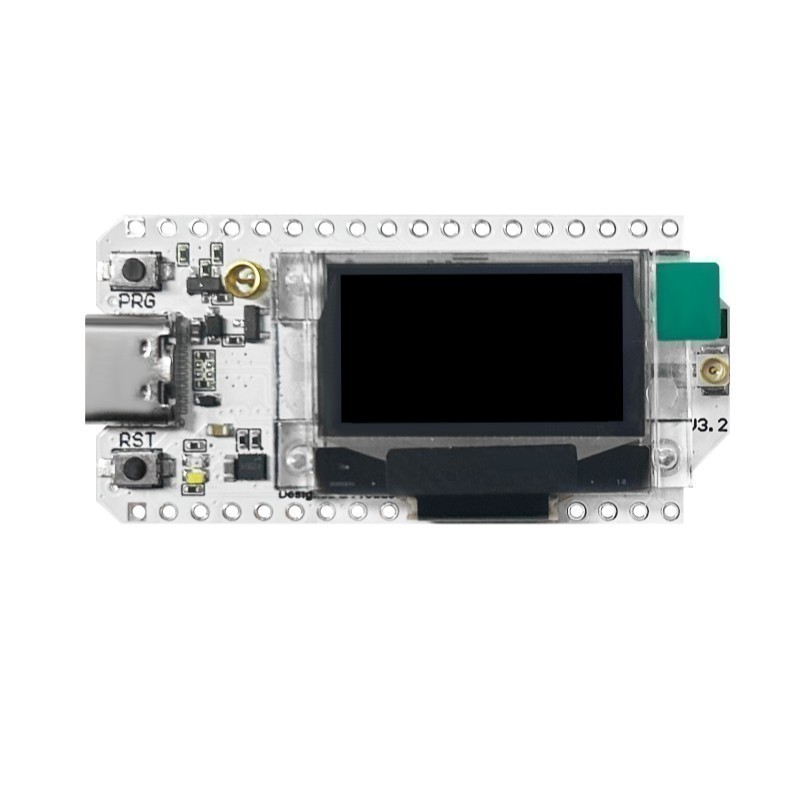
The Heltec WiFi LoRa 32 V3 is the USB-C SX1262 base our disaster-comms guide assumes as Node 1. ESP32-S3, 0.96-inch OLED, WiFi, BLE 5.0, LiPo charger, 50.2 x 25.5 mm. No GNSS, no 18650 cage — pair a T-Beam Supreme. V4 is a separate product.
Best compact USB-C Meshtastic base station — skip if you need GNSS or an 18650 holder.
Where to Buy
Pros
- SX1262 on USB-C with a 0.96-inch OLED — flash Meshtastic and leave it on a wall wart as Node 1
- ESP32-S3 adds WiFi and BLE 5.0 so the phone app pairs without a second radio
- 50.2 x 25.5 mm footprint fits a printed case on an eave or shelf
- LiPo charging via SH1.25 — fine for a spare pack, not a substitute for an 18650 go-bag
- V3 Amazon hop is unchanged; we do not treat V4 as a silent swap
Cons
- No GNSS — position sharing needs a T-Beam Supreme or an external module
- No 18650 holder — SH1.25 LiPo only, and polarity is easy to reverse
- Stock stub antenna: urban range is 0.5–2 km, not the datasheet line-of-sight figure
- SX1262 TX is 21±1 dBm; RX is about -134 to -137 dBm, not the chip's -148 dBm headline
- About 20 GPIO remain after LoRa and the OLED eat pins
Node 1: LoRa and Meshtastic
Our disaster-comms guide treats the Heltec V3 as the always-on household base. Flash the V3 profile at flasher.meshtastic.org, park it on USB-C, mount a real antenna as high as we can. The T-Beam Supreme is the other half of that pair — GNSS and 18650 in the go-bag. One board does not replace the other.
The SX1262 runs 868 MHz in the EU or 915 MHz in the US. Meshtastic turns each node into a relay: encrypted text, telemetry, and a phone app over BLE. A handful of nodes covers a campus or a valley only if each hop actually hears the next — one node is a paperweight. Flashing takes a few minutes: USB-C, Chrome, Heltec V3 profile. The 0.96-inch OLED comes up with channel and node count. Pair the phone app and we are on the mesh without soldering.
Heltec V4 is a new product on this site with its own hop. We do not retarget V3 to V4. The V3 Amazon dest stays B0DRSJV1ZL. If we want the V4 GNSS header and 16 MB flash, buy that page. If we want the board this guide assumes, stay on V3.
Range testing and antenna upgrades
The SX1262 here is specified at 21±1 dBm transmit. Receive is about -134 to -137 dBm on the slow LoRa settings. Do not cite the bare chip's -148 dBm figure as if the Heltec front-end delivered it. Urban range with the stock stub is 0.5–2 km. Line-of-sight with a tuned 915 MHz whip and height is a different experiment.
The first upgrade is a tuned antenna through a U.FL pigtail, not a different MCU. The U.FL is fragile — seat it once and leave it. Buy the antenna hop, not a random SMA stuck on the stub. A directional Yagi on a fixed eave node is a height-and-aim project, not a reason to swap the radio.
Compared with the T-Beam Supreme, the V3 trades GNSS and an 18650 cage for a smaller 50.2 x 25.5 mm footprint and USB-C wall duty. The T-Beam's L76K is why Node 2 can say “I'm here” with coordinates. The V3 works as a stationary relay, a home base, or a pack node whose position we set by hand in the app. The kit we actually run is one V3 on USB-C and one T-Beam in the bag — not two of the same board.
SH1.25 polarity, battery, and OLED
The charger is a 3.7 V LiPo on an SH1.25-2P. Heltec's pinout is easy to reverse. Confirm polarity on the silkscreen before we plug a pack — a reversed lead can kill the charge IC. There is no 18650 cage. If we need swappable cells in a bag, that is the T-Beam, not a holder glued to this PCB.
Charge current is roughly 500 mA with no user limit. Skip cells under 500 mAh unless they are rated for that charge. For a base station we skip the pack entirely and run USB-C. A 1000 mAh pack can last a work day if the OLED auto-offs; the display itself is 20–30 mA when lit. Deep sleep can drop toward 20 µA only if firmware actually shuts the SSD1306 down. Leave the panel running and we stay in the tens of milliamps.
The 0.96-inch 128x64 OLED is why this board works as a base we can glance at without unlocking a phone. In Meshtastic it cycles messages, node count, battery, and channel. For custom firmware the SSD1306 sits on I2C and shares that bus with a BME280. The limit is four short lines of text — status, not a novel. About 20 GPIO remain after LoRa and the screen. This is a radio node, not a sensor farm.
USB-C base versus go-bag versus V4
The V3 sits where the disaster-comms guide puts it: indoor or eave relay on wall power. Same SX1262 family as the T-Beam. Same reason we still buy both. The T-Beam is larger (114 x 33 x 28 mm) because it carries L76K and an 18650 spring cage. The V3 is the card that lives on a USB brick. Do not skip the V3 because we already bought a T-Beam. Do not skip the T-Beam because the V3 is smaller.
Battery philosophy is the split. V3 is SH1.25 LiPo or no pack at all. T-Beam is an unprotected flat-top 18650. There is no dedicated solar JST on the Supreme either — AXP2101 over USB-C at 3.9–6 V — so a 5 V USB panel is the outdoor path for that board, not a mystery solar pad from an older T-Beam drawing. For a plugged-in indoor node the V3 pack is irrelevant. For multi-day field days the 18650 wins. For unattended hilltop sleep current, we still point at RAK WisBlock, not this ESP32-S3.
Range still follows antenna and height. A V3 with a tuned 915 MHz whip on an eave will beat a T-Beam with a stub in a pocket. The radio does not get smarter because the PCB is longer. Choose V3 for USB-C Node 1. Choose T-Beam for GNSS Node 2. Choose V4 only if we want that product's GNSS header and extra flash — not because we think the Amazon listings merged.
Common gotchas
The OLED rides I2C on pins that collide with some sensor libraries' defaults. If an I2C sensor stays silent, check the bus against the screen before we blame the module. Use the second I2C bus or move the sensor.
The stock stub is the range limiter. Urban 0.5–2 km is what we write. Treat 10 km line-of-sight as an antenna-and-height claim. The U.FL hates repeated mates — seat a pigtail once.
Deep sleep current stays high if the SSD1306 is not powered down. Call the display-off path before sleep or the controller keeps drawing 10–15 mA.
The LiPo charger is about 500 mA with no configurable limit. Small packs under 500 mAh get stressed unless they are rated for that rate. For Node 1 we run USB-C and skip the pack.
SH1.25 polarity is the brick we see most. Check the silkscreen. Reverse the leads and the charge IC can die before the first mesh ping.
Full Specifications
Processor
| Specification | Value |
|---|---|
| Architecture | Xtensa LX7 [1] |
| CPU Cores | 2 [1] |
| Clock Speed | 240 MHz [1] |
Memory
| Specification | Value |
|---|---|
| Flash | 8 MB [1] |
| SRAM | 512 KB [1] |
Connectivity
| Specification | Value |
|---|---|
| WiFi | 802.11 b/g/n [1] |
| Bluetooth | 5.0 [1] |
| lora | SX1262 (868/915MHz) [1] |
| lora_range | Up to 10km line-of-sight [1] |
| meshtastic | Fully supported [1] |
I/O & Interfaces
| Specification | Value |
|---|---|
| Display | 0.96" OLED (128x64) [2] |
| GPIO Pins | 20 [2] |
| ADC Channels | 2 [2] |
| SPI | 2 [2] |
| I2C | 1 [2] |
| UART | 2 [2] |
| USB | USB-C [2] |
Power
| Specification | Value |
|---|---|
| Input Voltage | 3.3-7 V [1] |
| Battery Charging | Single-cell LiPo charger [1] |
| Deep Sleep Current | ~20 uA [1] |
Physical
| Specification | Value |
|---|---|
| Dimensions | 50.2 x 25.5 mm [2] |
| Form Factor | Compact with OLED + antenna [2] |
Who Should Buy This
This is Node 1 in our disaster-comms guide: USB-C, SX1262, OLED. Leave it powered. Skip if the node has to carry GNSS or an 18650 in a bag — that is the T-Beam Supreme.
No GNSS, no 18650 cage. The T-Beam Supreme is Node 2 for that job.
Better alternative: LILYGO T-Beam Supreme
V3 works on USB solar banks. For sub-30 µA unattended outdoor duty, the RAK WisBlock kit is the Node 3 we spec.
Better alternative: RAK WisBlock Meshtastic Starter Kit
ESP32-S3 still reads I2C/SPI sensors and can dump over WiFi when the AP is up. Treat urban stock range as 0.5–2 km, not a 10 km valley claim. Antenna and height decide the hop, not the MCU.
Ecosystem & Community
Heltec V3 is the USB-C Meshtastic base in our disaster-comms pair. Firmware lives in the Meshtastic org; the T-Beam Supreme is the GNSS go-bag counterpart.
Compatible Software
What to Build First
Flash Meshtastic on the V3, leave it on USB-C, mount a tuned 915 MHz antenna. This is the household base our disaster-comms guide assumes. Pair a T-Beam Supreme as Node 2.
View tutorial →Must-Have Accessories
Video Reviews & Tutorials
Tutorials & Resources
- Meshtastic Getting Started GuideOfficial setup guide for all supported devicestutorial
- PAM disaster-comms guideNode 1 / Node 2 household kit this review pairs withdocs
Frequently Asked Questions
Is this the board the disaster-comms guide assumes?
Yes. Node 1 is the Heltec V3 on USB-C. Node 2 is the T-Beam Supreme. Read both reviews for SH1.25 polarity, 18650 fit, and U.FL notes before flashing.
Heltec V3 vs T-Beam Supreme?
V3 is the compact USB-C base: no GNSS, no 18650. T-Beam Supreme is the GNSS + 18650 go-bag. We run both. Skip V3 if the only node we will buy has to carry coordinates in a bag.
How far does the V3 reach with the stock antenna?
Urban with the stub: 0.5–2 km. Treat 10 km line-of-sight as an antenna-and-height claim, not a living-room measurement. Upgrade the 915 MHz antenna before we buy a second radio. TX is 21±1 dBm; RX is about -134 to -137 dBm, not the chip -148 dBm headline.
Should we buy V4 instead?
No as a silent swap. V4 is a different product (GNSS header, more flash). This page and hop stay V3 (Amazon dest B0DRSJV1ZL). Buy V4 only if we want those headers, not because we think the listings merged.
What is the SH1.25 polarity gotcha?
The LiPo connector is SH1.25-2P. Reverse polarity is a common brick. Check the board marking before plugging a pack. For Node 1 we run USB-C and skip the pack.
Can we use the Heltec V3 without Meshtastic?
Yes. It is a standard ESP32-S3 board with an SX1262. Arduino, PlatformIO, or ESP-IDF all work for custom LoRa or sensor firmware. Most of us still flash Meshtastic because the V3 profile is one click.
What antenna do we need?
The board ships a stub. For usable urban range, add a U.FL-to-SMA pigtail and a tuned 868/915 MHz whip. The antenna jack is U.FL, not SMA. Seat the pigtail once — U.FL is fragile.
Compared In
Heltec WiFi LoRa 32 V3 appears in 12 buying guides on PAM Finds. These weigh it directly against the alternatives.
- Heltec V3 vs T-Beam: Best Meshtastic Board?
- Meshtastic vs MeshCore: Which Protocol Wins?
- RAK vs Heltec V3 vs T-Beam: Meshtastic Showdown
- Disaster Comms with Meshtastic + MeshCore (2026)
- Meshtastic GPS Tracker with ESP32 + LoRa: Complete Build
- GMRS vs FRS vs Ham Radio: License + Hardware Guide
- Meshtastic Getting Started: First Message in 30 Min
- Best Disaster Comms Mesh Bundle 2026