SparkFun Thing Plus - ESP32-S3
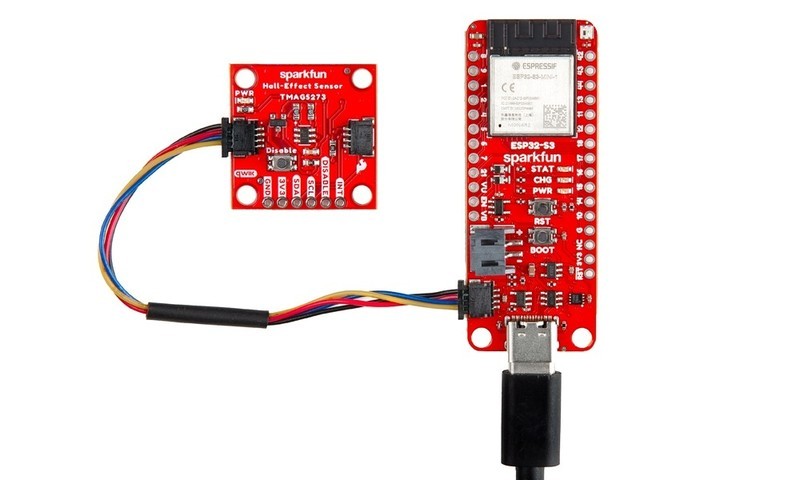
The SparkFun Thing Plus ESP32-S3 is a feature-rich Feather-compatible board with 16MB flash, 8MB PSRAM, Qwiic I2C connector, MicroSD slot, LiPo charger with fuel gauge, and USB-C OTG. It packs the most peripheral integration of any ESP32-S3 board, designed for data logging and field-deployed projects.
Best for data logging and field deployments needing battery, SD card, and Qwiic, skip if size or cost is the primary concern.
Where to Buy
Pros
- 16MB flash — double the standard, room for large firmware, OTA, and file systems
- MAX17048 fuel gauge provides accurate battery percentage readings
- MicroSD card slot for local data logging without WiFi dependency
- Qwiic / STEMMA QT connector for plug-and-play I2C sensors
- Single-cell LiPo charger with power path management
Cons
- Higher price point than Espressif reference boards and XIAO alternatives
- 58.4x22.9mm is larger than the XIAO (21x17.5mm) or QT Py (22x17.8mm)
- 21 GPIO pins — fewer than the DevKitC's 45 due to Feather form factor
Peripheral Integration
The Thing Plus stands out for what SparkFun built around the ESP32-S3 chip. The MicroSD card slot provides local storage independent of WiFi connectivity — critical for field-deployed sensors that operate in areas without reliable network access. Data logs to SD via the SPI interface while WiFi uploads in batches when connectivity is available. The MAX17048 fuel gauge IC gives accurate battery percentage readings over I2C — most boards only tell you voltage, which maps poorly to remaining capacity due to the nonlinear LiPo discharge curve.
The Qwiic connector is compatible with SparkFun's 300+ Qwiic sensor breakouts and Adafruit's STEMMA QT ecosystem, providing access to roughly 500+ plug-and-play I2C sensors, displays, and GPS modules. This I2C plug-and-play system eliminates wiring errors and speeds up prototyping. Combined with the MicroSD, you can build a complete data logging system — sensor, storage, and battery management — with no soldering. A typical field deployment: Qwiic GPS module for location, Qwiic BME688 for environmental sensing, MicroSD for local storage, and LiPo with solar panel for power.
The 21 GPIO pins in Feather-compatible pinout mean compatibility with Adafruit's Feather Wing add-on ecosystem. Motor controllers, GPS modules, OLED displays, and LoRa radios in Feather Wing form factor stack directly onto the Thing Plus. This dual-ecosystem compatibility — SparkFun Qwiic plus Adafruit Feather — gives the Thing Plus the broadest accessory support of any ESP32-S3 board.
Storage and Memory
16MB of flash is double what Espressif's reference boards offer. This extra storage matters for three scenarios: large OTA update partitions (you can keep the current 6MB firmware while downloading the replacement, with a 3MB SPIFFS partition for web assets), extensive LittleFS file systems for web server assets and configuration storage, and fat firmware images with many libraries. ESPHome builds with many sensors and automations routinely exceed 1.5MB, and with 16MB flash you can allocate dual 6MB OTA slots without constraints.
The 8MB PSRAM matches the DevKitC and XIAO, providing ample buffer space for data processing, camera frames, or ML model weights. The combination of 16MB flash and 8MB PSRAM gives the Thing Plus the highest total onboard memory of any ESP32-S3 board in this comparison at 24MB. For projects that buffer data locally before uploading — environmental monitoring logging thousands of readings, audio recording for later analysis, or map tile caching — this memory headroom prevents the out-of-memory failures that plague 4MB flash boards.
The MicroSD card slot adds effectively unlimited storage via SPI. Industrial-grade 32GB MicroSD cards rated for continuous writes (designed for dashcams and security cameras) are recommended for data logging applications. Standard consumer SD cards can develop write errors after 10,000-100,000 write cycles to the same sector, while industrial cards tolerate millions of cycles.
Battery Management
The single-cell LiPo charger charges at up to 500mA via USB-C when connected and automatically switches to battery when USB is disconnected. Power path management means the device runs from USB power while charging the battery, rather than cycling through the battery — this extends battery cycle life by avoiding unnecessary discharge-charge cycles during development.
The MAX17048 fuel gauge is the real differentiator and the feature that justifies the Thing Plus's price premium over bare ESP32-S3 boards. It uses a ModelGauge algorithm to estimate remaining battery capacity from voltage curves, compensating for temperature, load current, and battery aging. Your firmware reads battery percentage over I2C (address 0x36) with 1% resolution and can make intelligent decisions — transmit a low-battery alert at 15%, reduce sample rate to extend life below 10%, or trigger a graceful shutdown with data flush to SD at 5%.
For solar-charged deployments, the charger accepts input from a 5-6V solar panel via USB-C. The fuel gauge tracks state-of-charge through solar charging cycles, providing accurate remaining capacity even as the panel intermittently charges during cloud cover. This combination of charging, monitoring, and local storage makes the Thing Plus the most field-deployment-ready ESP32-S3 board available without custom PCB design.
SparkFun Qwiic Ecosystem
The Qwiic connector on the Thing Plus is a 4-pin JST SH (1mm pitch) carrying I2C data (SDA, SCL) plus 3.3V power and ground. It is electrically identical to Adafruit's STEMMA QT connector, which means the Thing Plus plugs into both SparkFun's 300+ Qwiic breakout boards and Adafruit's 200+ STEMMA QT peripherals — over 500 plug-and-play sensors, displays, relays, and communication modules accessible without soldering a single wire.
The practical value is speed. Connecting a BME688 environmental sensor to the Thing Plus takes 3 seconds: plug in the Qwiic cable, upload example code, read data. No breadboard, no resistor calculations, no I2C pull-up resistor debugging. Daisy-chaining is built in — each Qwiic board has two connectors, so you chain sensor to sensor to sensor. A typical field deployment might chain a Qwiic GPS (SAM-M10Q), a Qwiic environmental combo (BME688), and a Qwiic OLED display (SSD1306, 128x64 pixels) — three peripherals connected in under 30 seconds, all sharing the same I2C bus at addresses 0x42, 0x76, and 0x3C respectively.
The LiPo charging circuit with MAX17048 fuel gauge adds another dimension to the Thing Plus's field-readiness. SparkFun designed the power path so USB-C charges the battery while simultaneously powering the board — no discharge cycles wasted during bench development. The fuel gauge reads battery state-of-charge over I2C at address 0x36, integrating seamlessly into the same Qwiic data pipeline as your sensors. Your firmware can log battery percentage alongside environmental data to the MicroSD card, creating a complete deployment health record.
The Thing Plus form factor itself is part of SparkFun's standardization strategy. The Feather-compatible pinout means you can swap the ESP32-S3 brain for a different Thing Plus variant — nRF52840 for BLE-only, RP2040 for dual-core ARM, STM32 for industrial applications — while keeping the same Qwiic sensor chain, the same LiPo battery, and the same enclosure. This modularity reduces the cost of experimentation: buy the sensors once, swap the processor to match the project requirements.
Full Specifications
Processor
| Specification | Value |
|---|---|
| Architecture | Xtensa LX7 [1] |
| CPU Cores | 2 [1] |
| Clock Speed | 240 MHz [1] |
Memory
| Specification | Value |
|---|---|
| Flash | 16 MB [1] |
| SRAM | 512 KB [1] |
| PSRAM | 8 MB [1] |
Connectivity
| Specification | Value |
|---|---|
| WiFi | 802.11 b/g/n [1] |
| Bluetooth | 5.0 [1] |
I/O & Interfaces
| Specification | Value |
|---|---|
| GPIO Pins | 21 [2] |
| ADC Channels | 14 [2] |
| SPI | 2 [2] |
| I2C | 1 [2] |
| UART | 2 [2] |
| USB | USB-C (OTG) [2] |
| Qwiic | 1x Qwiic / STEMMA QT [2] |
| SD Card | MicroSD slot [2] |
Power
| Specification | Value |
|---|---|
| Input Voltage | 5 V [1] |
| Deep Sleep Current | ~10 uA [1] |
| Battery Charging | Single-cell LiPo charger [1] |
| Fuel Gauge | MAX17048 fuel gauge [1] |
Physical
| Specification | Value |
|---|---|
| Dimensions | 58.4 x 22.9 mm [2] |
| Form Factor | Thing Plus (Feather-compatible) [2] |
Who Should Buy This
MicroSD logs data locally when WiFi is unavailable. LiPo charger with fuel gauge manages solar-charged batteries. Qwiic connects weather sensors without soldering. 16MB flash holds weeks of buffered data.
Qwiic GPS module connects instantly. MicroSD stores track logs. Fuel gauge reports battery level to the application. Feather form factor fits standard enclosures.
SparkFun boards carry a premium for their integration and documentation. The XIAO ESP32S3 has the same chip with battery charging at a lower price, or the ESP32-S3-DevKitC for raw capability.
Better alternative: Seeed Studio XIAO ESP32S3
At 58.4x22.9mm, it is 3x larger than the XIAO. The Feather form factor is designed for enclosures, not wearables.
Better alternative: Seeed Studio XIAO ESP32S3
Ecosystem & Community
The Thing Plus integrates with SparkFun's Qwiic ecosystem (300+ I2C sensor boards) and is compatible with Adafruit Feather Wings, giving access to two major accessory ecosystems.
Compatible Software
What to Build First
Build a remote environmental monitor that logs GPS coordinates, temperature, humidity, and pressure to a MicroSD card every 5 minutes. Solar panel charges the LiPo, fuel gauge reports battery health via WiFi when in range.
View tutorial →Must-Have Accessories
Tutorials & Resources
- SparkFun Thing Plus ESP32-S3 Hookup GuideOfficial hookup guide covering hardware overview, Qwiic connections, SD card usage, and battery managementtutorial
- SparkFun Qwiic Ecosystem OverviewComplete catalog of 300+ Qwiic-compatible sensors, displays, and accessoriesdocs
- SparkFun Thing Plus ESP32-S3 Hardware RepoSchematics, Eagle files, and hardware documentation for the Thing Plus ESP32-S3github
Frequently Asked Questions
What is the fuel gauge and why does it matter?
The MAX17048 fuel gauge IC estimates remaining battery percentage using voltage modeling. Unlike raw voltage readings which vary with load and temperature, the fuel gauge provides accurate state-of-charge. Your firmware can report actual battery percentage to users or adjust behavior based on remaining power.
Is the Thing Plus compatible with Feather accessories?
Yes. The Thing Plus uses the Feather-compatible form factor with matching pin layout. Feather Wings (add-on boards) from Adafruit, SparkFun, and third parties should be compatible, though always verify pin assignments for your specific Wing.
Thing Plus vs XIAO ESP32S3: which should I choose?
Choose the Thing Plus for data logging (SD card), battery monitoring (fuel gauge), and Qwiic ecosystem. Choose the XIAO for compact size (21mm vs 58mm). Both have 8MB PSRAM and battery charging, but the Thing Plus adds SD and fuel gauge.
Can I use the MicroSD card and WiFi simultaneously?
Yes. The SD card uses SPI, not the same interface as WiFi. You can log data to SD while maintaining a WiFi connection. The ESP32-S3's dual-core architecture handles both tasks on separate cores without conflict.
Does the Thing Plus support camera modules?
The ESP32-S3 chip supports cameras via DVP interface, but SparkFun does not break out the camera pins on the Thing Plus. For camera projects, use the ESP32-S3-DevKitC or XIAO ESP32S3 Sense.
Compared In
SparkFun Thing Plus - ESP32-S3 appears in 3 buying guides on PAM Finds. These weigh it directly against the alternatives.