Official Arduino Starter Kit
The Official Arduino Starter Kit pairs a genuine Arduino Uno R3 board with a 170-page printed project book covering 15 projects that teach electronics theory, circuit design, and programming from absolute zero. At approximately $85, it is the most education-focused kit available, designed by the Arduino team specifically for structured learning rather than maximum component count.
The best-written project book in the electronics education space — buy if you value guided learning from the source, skip if you want component variety or modern USB-C connectivity.
Where to Buy
Pros
- 170-page printed project book is the gold standard for beginner electronics education — teaches theory, not just wiring
- Genuine Arduino Uno R3 board with official support, warranty, and guaranteed IDE compatibility
- 15 projects progress from basic circuits to complex interactive systems with clear conceptual explanations
- The book teaches transferable electronics knowledge — voltage dividers, capacitor behavior, transistor switching — not just Arduino-specific skills
- Supports Arduino's open-source ecosystem financially — purchasing funds continued development of the IDE and libraries
Cons
- Approximately $85 for roughly 70 components — the Elegoo kit offers 200+ components at under half the price
- USB-B connector is outdated — most modern devices use USB-C, and you likely don't have a USB-B cable spare
- Only 15 projects compared to Elegoo's 33 or Freenove's 62 — limited project variety after completing the book
- No WiFi, Bluetooth, or modern connectivity — strictly wired projects with the included Uno R3
The 170-Page Project Book
Arduino's project book is the kit's primary value proposition — and it justifies the price premium for the right learner. Written by Arduino's education team and refined over a decade of classroom use, it covers 15 projects that each introduce new electronics concepts alongside new code patterns. The book assumes zero prior knowledge of electronics or programming.
Each project opens with a conceptual introduction explaining the physics: what is a capacitor and why does it smooth voltage? How does a transistor amplify a signal? Why do motors need flyback diodes? These explanations use analogies (water flowing through pipes, traffic on highways) that non-technical readers can grasp. The code sections are similarly thorough, explaining not just what each line does but why that approach was chosen.
The 15 projects progress through spaceship interface (LEDs + button), love-o-meter (temperature sensor + LED bar), color mixing lamp (RGB LED + photoresistors), motorized pinwheel (DC motor + transistor), zoetrope (motor speed control + potentiometer), and culminating in a keyboard instrument and motorized hourglass. Each project builds on concepts from previous ones, creating a coherent curriculum rather than isolated experiments.
The Genuine Arduino Uno R3
The included board is a genuine Arduino Uno R3 manufactured by Arduino — the ATmega328P at 16MHz with 32KB flash and 2KB SRAM, exactly like the Elegoo clone, but with the official Arduino branding, ATmega16U2 USB-serial chip, and Arduino's warranty. The ATmega16U2 provides better USB compatibility than clone CH340G chips, requiring zero driver installation on any operating system released after 2008.
The genuine board guarantees that every Arduino tutorial, library, and shield works without modification or driver debugging. For beginners, this eliminates a common first-hour frustration that clone boards sometimes introduce. The board's blue PCB with gold-plated Arduino logo also has intangible value as a motivational object — it feels official and premium in a way that generic green PCB clones do not.
The notable downside is the USB-B connector — a chunky square port that most people no longer have cables for, since the industry moved to micro-USB and then USB-C over the past decade. The kit includes a USB-B cable, but if you lose it, finding a replacement requires specifically purchasing one. The Arduino Uno R4 series upgraded to USB-C, but is not included in this kit.
Component Selection: Quality Over Quantity
The kit includes approximately 70 components: resistors (220, 1K, 10K ohm), capacitors (100uF, 100nF), LEDs (red, green, blue, RGB), pushbuttons, potentiometer, photoresistors, temperature sensor (TMP36), tilt switch, DC motor, small servo, piezo buzzer, H-bridge motor driver (L293D), LCD display (16x2), and an assortment of diodes, transistors, and jumper wires.
Notably absent compared to competing kits: no ultrasonic sensor, no stepper motor, no OLED display, no IR remote, no accelerometer, no humidity sensor, and no buzzer module. The Elegoo kit includes all of these plus 130+ additional components at half the price. The Arduino kit intentionally limits component count to match the 15-project curriculum — every included part is used, nothing sits unused in the box.
Component quality is good but not exceptional — comparable to mid-range components, below SparkFun's premium parts. The included breadboard is standard quality with adequate contact grip. The carrying case is cardboard (not plastic like SparkFun's) but well-designed with illustrations on the dividers showing where each component type belongs.
Learning Outcomes and Limitations
After completing all 15 projects, a learner will understand: digital and analog I/O, voltage dividers, current limiting, capacitor smoothing, transistor switching, H-bridge motor control, serial communication, LCD interfacing, and basic control loop programming. These concepts transfer directly to any microcontroller platform — ESP32, STM32, PIC, or Raspberry Pi Pico.
The book teaches transferable electronics knowledge rather than Arduino-specific tricks. A learner who finishes this kit can read a schematic, calculate resistor values from Ohm's law, choose the right transistor for a load, and debug circuits with a multimeter. This is a deeper foundation than what tutorial-focused kits (Elegoo, Freenove) typically produce, where learners can build documented circuits but struggle to design original ones.
The limitation is scope — 15 projects cover fundamentals thoroughly but leave intermediate and advanced topics (interrupts, timers, SPI/I2C communication, power management) for self-study. The natural next step is expanding with additional components and online tutorials (Adafruit, SparkFun learn), or upgrading to the Arduino Uno R4 WiFi for wireless capabilities within the same ecosystem.
The 170-Page Projects Book
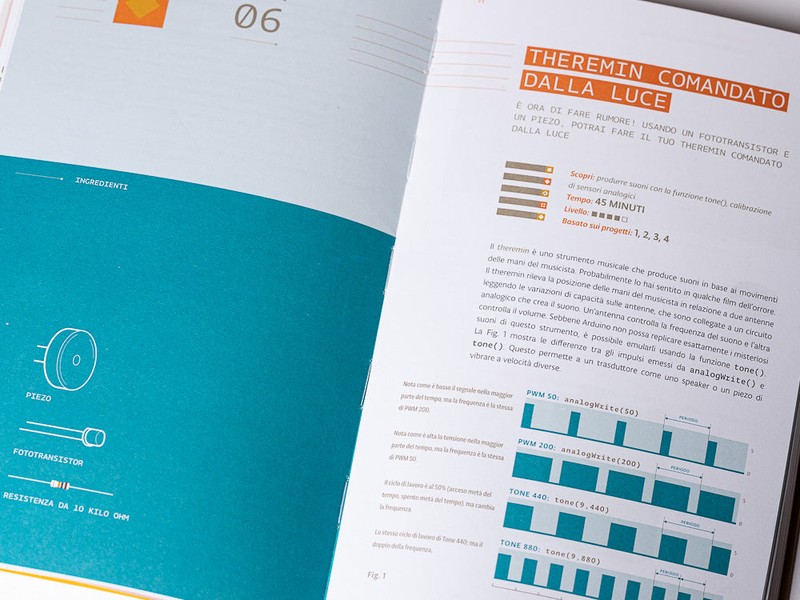
The physical book included in the Arduino Starter Kit is a 170-page, full-color, spiral-bound manual covering 15 progressive projects — from a spaceship interface (LEDs and a pushbutton) to a crystal ball (LCD display with tilt sensor and random answers). Each project builds directly on concepts introduced in previous ones, creating a structured curriculum rather than a collection of isolated experiments. Project 5 (mood cue, a servo-driven dial) introduces analog input with a potentiometer, and Project 6 (light theremin) reuses that analog input knowledge with a photoresistor and piezo buzzer. By Project 14 (tweaking the Arduino logo on an LCD), learners have accumulated enough skills to design original circuits without step-by-step guidance.
Physical documentation matters more than most makers realize. Beginners switching between a tutorial on screen and a circuit on the workbench lose context with every alt-tab. The spiral binding lies flat next to the breadboard — circuit diagram on the left page, code walkthrough on the right, both visible simultaneously while your hands work. This tactile learning flow is measurably more efficient for motor-skill tasks like inserting components and routing jumper wires. Research on procedural learning consistently shows that physical reference materials reduce error rates compared to screen-based instructions for hands-on tasks.
The pedagogical progression is what justifies the $85 price premium over clone kits with free PDF tutorials. Elegoo's 33 tutorials teach you to replicate circuits. Arduino's 15 projects teach you to understand circuits. Each chapter opens with the physics — what is capacitance, why does a motor need a flyback diode, how does PWM simulate analog output — before showing the wiring. By Project 15, learners can calculate resistor values from Ohm's law, predict transistor behavior in switching circuits, and debug circuits with a multimeter. These transferable skills apply to ESP32, STM32, Raspberry Pi Pico, or any microcontroller platform. The book creates electronics engineers, not Arduino-only hobbyists.
Full Specifications
Who Should Buy This
The 170-page project book is widely considered the best beginner electronics book available — written by Arduino's education team with decades of teaching experience. It teaches what a resistor does, why you need one, and how to calculate the right value. No other kit's documentation reaches this pedagogical quality.
Official Arduino hardware with warranty, printed curriculum-quality documentation, and Arduino's education team support. Some programs and certifications require genuine Arduino hardware. The brand credibility matters for institutional purchasing decisions.
At roughly $85, you get 70 components and 15 projects. The Elegoo kit delivers 200+ components and 33 tutorials at approximately $37. If you prefer learning by doing (trial and error with many components) over structured reading, Elegoo provides far better value.
Better alternative: Elegoo UNO R3 Super Starter Kit
The high-quality book and official branding make it a premium gift, but the $85 price is a significant investment for an uncertain interest. The Elegoo kit at $37 carries less financial risk if the recipient doesn't continue. However, the Arduino book is more engaging for non-technical readers.
Better alternative: Elegoo UNO R3 Super Starter Kit
The book excels at teaching electronics (voltage, resistance, capacitance) to people who already understand software. However, experienced programmers may find the programming explanations too basic. The SparkFun kit offers similar theory depth with a Qwiic ecosystem for faster hardware experimentation.
Better alternative: SparkFun Inventor's Kit (SIK) v4.1
Ecosystem & Community
The Official Arduino Starter Kit is the canonical entry point designed by Arduino's education team. The 170-page project book teaches electronics theory alongside 15 progressive projects. After the kit, you access the full Arduino ecosystem — shields, IoT cloud, and the largest hobbyist electronics community.
Compatible Software
What to Build First
The book starts with electronics fundamentals — what is a circuit, how does current flow, what does a resistor do — before you touch any code. Then you build your first LED circuit with full understanding. The pedagogical approach makes this the best-written electronics education available.
View tutorial →Must-Have Accessories
Video Reviews & Tutorials
Tutorials & Resources
- Arduino Getting Started GuideOfficial IDE setup, first sketch upload, and troubleshootingdocs
- Arduino Project Hub10K+ community projects with full code, wiring, and step-by-step instructionstutorial
- Arduino Language ReferenceComplete programming reference for all Arduino functions and librariesdocs
Frequently Asked Questions
Official Arduino Starter Kit vs Elegoo kit — is the Arduino kit worth 2x the price?
The Arduino kit's value is in its project book — widely considered the best beginner electronics education resource available. If you learn best from structured reading and want to understand theory, yes. If you prefer maximum components and learning by experimentation, Elegoo's 200+ components at $37 is better value.
Is the genuine Arduino board meaningfully better than an Elegoo clone?
Functionally, both run the same ATmega328P with identical behavior. The genuine board uses the ATmega16U2 USB chip (zero driver issues) vs Elegoo's CH340G (occasional driver install needed). You also get warranty and fund open-source development. For learning, the difference is negligible.
Can I use this kit's components with a different Arduino board later?
Yes. All included sensors, LEDs, resistors, motors, and the LCD work with any Arduino-compatible board — Uno R4, Mega, Nano, or even ESP32 boards running the Arduino framework. The components are generic through-hole parts, not proprietary.
Is the USB-B connector a real problem?
It is an inconvenience, not a dealbreaker. The kit includes a USB-B cable. The issue arises if you lose it — USB-B cables are uncommon in 2026 households. The Arduino Uno R4 WiFi uses USB-C, but is not included in this kit. Consider buying a spare USB-B cable when ordering.
How long will the 15 projects take to complete?
Working 2-3 hours per week, most beginners complete all 15 projects in 6-10 weeks. Each project takes 30-90 minutes depending on complexity and how thoroughly you read the theory sections. The book encourages experimentation after each project — extending them can double the timeline.
Is this kit appropriate for college electronics courses?
For introductory courses, yes — several universities use this kit as assigned coursework material. The genuine Arduino board and printed curriculum meet institutional standards. For advanced courses covering signals, power electronics, or embedded systems, you will need more specialized equipment.
What should I buy after finishing this kit?
For WiFi projects: Arduino Uno R4 WiFi (stays in the Arduino ecosystem). For more components and advanced projects: individual sensors from Adafruit or SparkFun. For a platform leap: Freenove ESP32-WROVER kit for IoT capabilities. The skills from this kit transfer to all three paths.
Compared In
Official Arduino Starter Kit appears in 1 buying guide on PAM Finds. These weigh it directly against the alternatives.