SenseCAP Card Tracker T1000-E
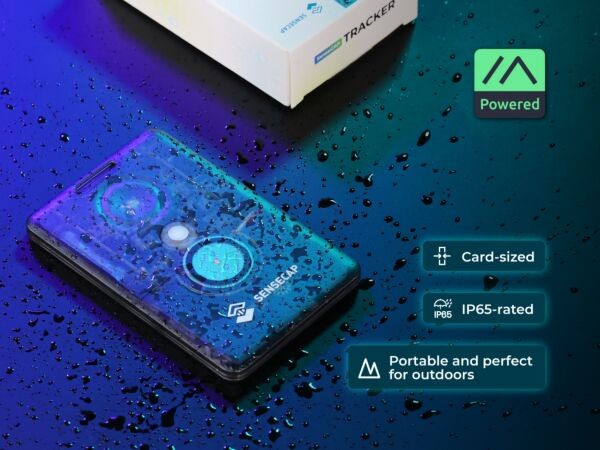
The SenseCAP Card Tracker T1000-E is a credit-card Meshtastic node: nRF52840, Semtech LR1110 (863–928 MHz), Mediatek AG3335 GNSS, 700 mAh cell, IP65, 85 x 55 x 6.5 mm, 32 g. No OLED, no keyboard. Magnetic pogo-pin charge cable. Seeed lists typical range 2–5 km on the internal antenna. It sits with the Wio Tracker L1 Pro under maker, not ESP32.
Buy as a pocket GPS tracker on Meshtastic — skip if we need a screen, a keyboard, or a week of battery like the L1 Pro.
Where to Buy
Pros
- Credit-card 85 x 55 x 6.5 mm and 32 g with IP65 — thinnest ready-made Meshtastic tracker we list
- LR1110 + AG3335 GNSS + nRF52840 BLE 5.1 in one sealed shell, Meshtastic pre-flashed
- 700 mAh magnetic-charge pack; no 18650 holder to print
- Seeed-branded Amazon listing; hop prefers that over clone cards
- Button multi-press actions (ping, GPS toggle, mute) without a display
Cons
- No screen and no keyboard — the phone app is the UI
- 700 mAh will not match the L1 Pro's 2000 mAh / 5–7 day claim
- Internal antenna; 2–5 km is Seeed's envelope, not a rooftop Yagi
- LR1110 cannot receive older SX127x Meshtastic packets without a hop through SX126x
Card tracker, not a communicator
The T1000-E is 6.5 mm thick. That is the point. We clip it, charge it on the magnetic puck, and let Meshtastic share position. There is no OLED. If we want to read channels on-device, that is the L1 Pro.
Seeed and Meshtastic docs agree on the radio caveat: LR1110 does not receive SX127x packets until the mesh hops through an SX126x (or the protocol break ships). Mix old Heltec V2-class nodes carefully.
Where it lives on this site
Chip is nRF52840, same class as the Wio Tracker L1 Pro, so the URL is under /maker/ — not /esp32/. Heltec V3/V4 stay in the ESP32 silo. That split matches how we already place nRF Meshtastic hardware.
Full Specifications
Processor
| Specification | Value |
|---|---|
| Architecture | ARM Cortex-M4 [1] |
| CPU Cores | 1 [1] |
| Clock Speed | 64 MHz [1] |
Memory
| Specification | Value |
|---|---|
| Flash | 1 MB [1] |
| SRAM | 256 KB [1] |
Connectivity
| Specification | Value |
|---|---|
| Bluetooth | 5.1 [1] |
| lora | LR1110 (863-928 MHz) [1] |
| lora_range | 2-5 km typical (internal antenna) [1] |
| meshtastic | Fully supported (pre-flashed) [1] |
I/O & Interfaces
| Specification | Value |
|---|---|
| gps | Mediatek AG3335 GNSS [2] |
| USB | Magnetic pogo-pin charge cable [2] |
| buttons | 1 user button (multi-press Meshtastic actions) [2] |
| buzzer | Yes [2] |
Power
| Specification | Value |
|---|---|
| battery | 700 mAh rechargeable [1] |
Physical
| Specification | Value |
|---|---|
| ip_rating | IP65 [2] |
| Dimensions | 85 x 55 x 6.5 mm [2] |
| weight_g | 32 g [2] |
| Form Factor | Credit-card tracker [2] |
Who Should Buy This
AG3335 GNSS, IP65, 32 g. Pair over BLE. Skip if we need an OLED or 2000 mAh.
L1 Pro has the 1.3-inch OLED, 2000 mAh, and joystick. T1000-E is the thinner tracker, not the communicator.
Better alternative: Seeed Studio Wio Tracker L1 Pro
No keys. T-Deck Plus is the Meshtastic handheld with a QWERTY and 2.8-inch IPS.
Better alternative: LilyGo T-Deck
Frequently Asked Questions
T1000-E vs Wio Tracker L1 Pro?
T1000-E is thinner (6.5 mm vs ~25 mm), IP65, 700 mAh, no screen. L1 Pro is 2000 mAh with a 1.3-inch OLED and joystick. Tracker versus EDC communicator.
Does it have a display?
No. Status is LED, buzzer, and the Meshtastic phone app over Bluetooth.
What battery life should we expect?
Seeed specifies a 700 mAh cell. That is not the L1 Pro's 5–7 day class. Duty cycle and GNSS fixes dominate; treat it as a charge-often tracker.
Will it talk to old SX127x nodes?
Meshtastic documents that LR1110 cannot receive SX127x packets directly. Transmitting works; receiving those packets needs an SX126x hop in the middle.
How do we flash firmware?
Seeed and Meshtastic point at UF2 / DFU via the pogo pins, not casual OTA. Use the T1000-E firmware image, not a generic nRF build.