ESP32-DevKitC V4
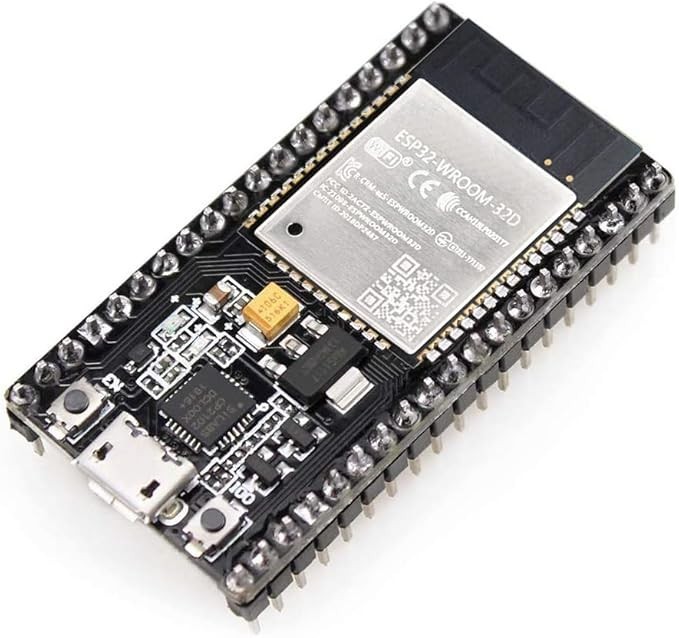
The ESP32-DevKitC V4 is Espressif's original dual-core development board, featuring the Xtensa LX6 at 240MHz with 4MB flash, WiFi, and Bluetooth 4.2. It remains the most widely documented and community-supported board in the ESP32 ecosystem, making it the safest starting point for new embedded developers.
Best for learning and community-supported projects, skip if you need BLE 5.0 or USB-OTG.
Where to Buy
Pros
- Dual-core Xtensa LX6 at 240MHz handles multitasking well for its class
- 34 GPIO pins — the most of any board in this roundup
- Largest library ecosystem and community documentation of any ESP32 variant
- Three UART interfaces for multi-sensor serial communication
Cons
- Bluetooth 4.2 lacks the range and throughput improvements of BLE 5.0
- Micro-USB with UART bridge — no native USB-OTG for HID or host mode
- No PSRAM limits on-device ML and large buffer applications
Processing Power
The ESP32 uses a dual-core Xtensa LX6 processor clocked at 240MHz. While newer chips like the ESP32-S3 use the faster LX7 architecture, the LX6 remains capable for most IoT workloads. Having two cores lets you dedicate one to WiFi/BLE stack management while the other runs application logic, which reduces latency in real-time applications. In practice, a web server handling 5-10 concurrent connections while reading I2C sensors every 100ms runs comfortably on the dual-core LX6 without noticeable lag.
For compute-intensive tasks like signal processing or encryption, the ESP32's dual-core approach still outperforms single-core RISC-V alternatives like the ESP32-C3 at 160MHz. AES-256 encryption runs at roughly 16MB/s on the ESP32 using the hardware accelerator, which is sufficient for TLS connections and encrypted data storage. However, it lacks the vector instructions found in the ESP32-S3 that accelerate neural network inference by 3-5x for multiply-accumulate operations.
Thermal behavior is well-characterized after years of community use. Under sustained dual-core load with WiFi active, the chip runs at approximately 50-60°C without a heatsink, well within the 125°C operating maximum. The original ESP32 does not throttle under normal ambient conditions, unlike some newer SoCs that aggressively clock down at elevated temperatures.
Memory and Storage
The DevKitC V4 ships with 4MB of flash storage and 520KB of SRAM. This is adequate for most IoT firmware but limiting for applications that need large buffers or on-device models. The absence of PSRAM is the biggest differentiator from the ESP32-S3, which offers up to 8MB. A typical Klipper firmware image or ESPHome configuration compiles to 1.2-1.8MB, leaving room for OTA partitions on the 4MB flash but not much else.
For typical sensor-reading, data-logging, and WiFi-connected applications, 520KB SRAM is sufficient. You will hit limits if you try to run a web server with large page buffers or process camera frames. The ESP-IDF memory allocator reports roughly 280-320KB free after WiFi and BLE stacks initialize, depending on configuration. MicroPython claims approximately 110KB of that for its heap, leaving 170-210KB for your application objects and buffers.
The 4MB flash supports partition schemes with dual OTA slots (1.5MB each) plus a 256KB SPIFFS or LittleFS partition for configuration storage. If you need a web server serving pages from flash storage, consider an external PSRAM-equipped variant or use the ESP32-S3-DevKitC with its 8MB flash and 8MB PSRAM for breathing room.
Connectivity and I/O
WiFi 802.11 b/g/n at 2.4GHz delivers typical throughput of 10-15 Mbps in real-world conditions with the PCB antenna, sufficient for MQTT telemetry, REST API calls, and web server hosting. Bluetooth 4.2 supports both Classic and BLE profiles, though the BLE range tops out at roughly 30-50 meters indoors compared to BLE 5.0's 100+ meters on the ESP32-C3. The 34 GPIO pins give the DevKitC more I/O flexibility than any other board in this comparison — the XIAO ESP32S3 has only 11, and the ESP32-C3 has 22.
With 18 ADC channels (12-bit resolution, though effective precision is closer to 10 bits due to noise on the ESP32's ADC), 4 SPI interfaces, 2 I2C buses, and 3 UARTs, the DevKitC can interface with a wide range of sensors and peripherals simultaneously. Two DAC channels provide analog output for audio or control signals. The capacitive touch sensor system on 10 pins enables button-free user interfaces without additional components.
The trade-off is the Micro-USB port with a CP2102 or CH340 UART bridge chip, which adds cost and board size compared to the native USB on newer ESP32 variants. The UART bridge limits USB to serial communication only — no HID, no mass storage, no MIDI. For projects needing native USB device capability, the ESP32-S3's USB-OTG 1.1 is the upgrade path. Framework support is the broadest in the ESP32 family: Arduino, ESP-IDF, MicroPython, CircuitPython, PlatformIO, ESPHome, WLED, and Tasmota all have mature, battle-tested support for the original ESP32.
The Original ESP32: Still Relevant in 2026
The original ESP32 launched in 2016, and a decade later it remains in active production and widely deployed. This longevity is not accidental — it reflects a massive ecosystem that newer chips have not yet replicated. Over 8 years of community development have produced thousands of tutorials on Random Nerd Tutorials, DroneBot Workshop, and Andreas Spiess's YouTube channel. Every Arduino library that supports "ESP32" was tested on this chip first. Every ESP-IDF example in Espressif's documentation targets this chip as the baseline. Stack Overflow has tens of thousands of answered ESP32 questions, and the overwhelming majority reference the original Xtensa LX6 variant.
The practical question for new projects in 2026 is whether to start with the original ESP32 or jump to the S3 or C6. The answer depends on your requirements. Choose the original ESP32 when you need proven stability for a production deployment, when your project relies on a library that has only been tested on the LX6, when your budget is tight (the DevKitC consistently sells for $4-6 on AliExpress), or when you simply do not need USB-OTG, AI vector acceleration, or Thread/Zigbee. A WiFi-connected relay controller, an MQTT temperature logger, a web-based LED controller, or a Bluetooth serial bridge — these projects run identically on the original ESP32 as on the S3, at lower cost and with more community examples to reference.
Upgrade to the ESP32-S3 when your project needs camera support via the DVP interface, native USB-OTG for HID devices or host mode, more than 4MB of PSRAM for image or audio buffers, or the S3's vector instructions for on-device neural network inference running 3-5x faster multiply-accumulate operations. Upgrade to the ESP32-C6 when you need Matter or Thread protocol support via its 802.15.4 radio for smart home interoperability. The original ESP32 lacks all of these features, but for the vast majority of WiFi IoT projects — which is what most makers actually build — the original chip delivers everything needed at the lowest price with the most proven codebase.
Power Efficiency
Deep sleep current of 10uA is reasonable but not class-leading. The ESP32-C3 achieves 5uA and the ESP32-S3 hits 7uA in deep sleep. For battery-powered applications running on coin cells, those microamps add up over months. A CR2032 coin cell (225mAh) would theoretically last 2.5 years at 10uA continuous, but real-world duty cycles with periodic WiFi wake-ups consuming 160-260mA during transmission reduce this to weeks or months depending on wake frequency.
For projects powered by USB or a wall adapter, the deep sleep difference is irrelevant. The 5V input voltage means you can power it from any standard USB charger or power bank. Active current draw with WiFi transmitting peaks at approximately 240mA, while WiFi receiving sits around 95-100mA. With WiFi in modem sleep mode between transmissions, average current drops to 15-20mA, making a 2000mAh LiPo battery viable for 4-5 days of periodic sensor reporting at 15-minute intervals.
Full Specifications
Processor
| Specification | Value |
|---|---|
| Architecture | Xtensa LX6 [1] |
| CPU Cores | 2 [1] |
| Clock Speed | 240 MHz [1] |
Memory
| Specification | Value |
|---|---|
| Flash | 4 MB [1] |
| SRAM | 520 KB [1] |
Connectivity
| Specification | Value |
|---|---|
| WiFi | 802.11 b/g/n [1] |
| Bluetooth | 4.2 [1] |
I/O & Interfaces
| Specification | Value |
|---|---|
| GPIO Pins | 34 [2] |
| ADC Channels | 18 [2] |
| SPI | 4 [2] |
| I2C | 2 [2] |
| UART | 3 [2] |
| USB | Micro-USB (UART bridge) [2] |
Power
| Specification | Value |
|---|---|
| Input Voltage | 5 V [1] |
| Deep Sleep Current | 10 uA [1] |
Physical
| Specification | Value |
|---|---|
| Dimensions | 55 x 28 mm [2] |
| Form Factor | Standard breadboard [2] |
Who Should Buy This
The most tutorials, examples, and community answers exist for the original ESP32. Every library and framework supports it.
34 GPIO pins and 3 UART interfaces handle multiple serial sensors without pin conflicts. 18 ADC channels for analog sensors.
No PSRAM and no camera interface. The ESP32-S3-DevKitC has 8MB PSRAM and a DVP camera interface for this use case.
Better alternative: ESP32-S3-DevKitC-1
BLE 4.2 works but lacks the range and connection density of BLE 5.0. The ESP32-C3 offers BLE 5.0 at a lower power draw.
Better alternative: ESP32-C3-DevKitM-1
Micro-USB with UART bridge cannot act as a native USB HID device. The ESP32-S3 has USB-OTG 1.1 for native HID.
Better alternative: ESP32-S3-DevKitC-1
Ecosystem & Community
The original ESP32 has the largest community and library ecosystem of any microcontroller — more tutorials, forum answers, and compatible libraries than any other ESP32 variant.
Compatible Software
What to Build First
The classic first ESP32 project: blink an LED, then serve a web page over WiFi to toggle it from your phone. Teaches GPIO, WiFi connectivity, and async web serving in under an hour.
View tutorial →Must-Have Accessories
Video Reviews & Tutorials

Tutorials & Resources
- Complete ESP32 Getting Started GuideThe most comprehensive beginner tutorial covering setup, GPIO, WiFi, and first projectstutorial
- ESP-IDF Programming GuideOfficial documentation for the ESP-IDF framework — the definitive reference for all ESP32 peripheralsdocs
- Arduino-ESP32 CoreThe Arduino core for ESP32 — enables Arduino IDE and PlatformIO development with 16K+ GitHub starsgithub
Frequently Asked Questions
Is the ESP32-DevKitC still worth buying in 2026?
Yes, if community support matters to you. The original ESP32 has the largest library ecosystem, the most tutorials, and the widest framework support. For new projects without specific hardware requirements, newer chips like the ESP32-S3 or ESP32-C3 offer better specs.
Can the ESP32-DevKitC run MicroPython?
Yes. MicroPython, CircuitPython, Arduino, ESP-IDF, and PlatformIO all support the original ESP32. It has the broadest framework compatibility of any ESP32 variant.
What is the difference between ESP32 and ESP32-S3?
The ESP32-S3 uses the newer Xtensa LX7 architecture (vs LX6), adds USB-OTG, supports up to 8MB PSRAM, has a camera interface, and includes AI vector instructions. The original ESP32 has more GPIO pins (34 vs 45 usable) and a larger existing codebase.
Does the ESP32-DevKitC support Thread or Matter?
No. Thread and Matter require an 802.15.4 radio, which the original ESP32 does not have. For Thread/Matter, use the ESP32-C6 (WiFi + Thread) or ESP32-H2 (Thread/Zigbee only).
How many sensors can I connect to the ESP32-DevKitC?
With 34 GPIO pins, 18 ADC channels, 4 SPI buses, 2 I2C buses, and 3 UARTs, you can connect dozens of sensors simultaneously. I2C alone supports up to 127 devices on a single bus.
Can I use the ESP32-DevKitC as a web server?
Yes. The dual-core processor lets you run a web server on one core while handling application logic on the other. The 520KB SRAM limits page size, so use lightweight frameworks like ESPAsyncWebServer rather than serving large HTML pages from memory.
Compared In
ESP32-DevKitC V4 appears in 19 buying guides on PAM Finds. These weigh it directly against the alternatives.
- ESP32 vs Arduino: Which Platform in 2026?
- ESP32 vs S3 vs C3: Which Chip? (2026)
- ESP32 vs STM32: Which Platform Should You Choose?
- Best PCB Assembly Services for Small Batch Orders in 2026
- Best PCB Design Software for Beginners in 2026
- From Breadboard to Custom PCB: Complete Beginner Guide
- Design a Custom ESP32 Board in KiCad + Order from JLCPCB
- Design a Custom ESPHome Sensor Board: Idea to Production
11 more
- Design a Custom Meshtastic LoRa Node PCB
- ESP32 Module vs Bare Chip: When to Use Each
- ESP32-S3 Bluetooth Proxy for Home Assistant (2026)
- WiFi Temperature Sensor with ESP32 and ESPHome
- JLCPCB vs PCBWay vs OSH Park: Best PCB Service in 2026
- KiCad to JLCPCB: Generate Gerbers, BOM & CPL Files
- PCB Import Tariffs 2026: What US Makers Need to Know
- WLED Setup with ESP32-S3: Complete LED Strip Guide
- WLED Quickstart: ESP32 DevKitC LED Strip Setup
- Best Budget ESP32 Boards Under $15 in 2026
- Best ESP32 Boards for WLED in 2026