Teensy 4.1
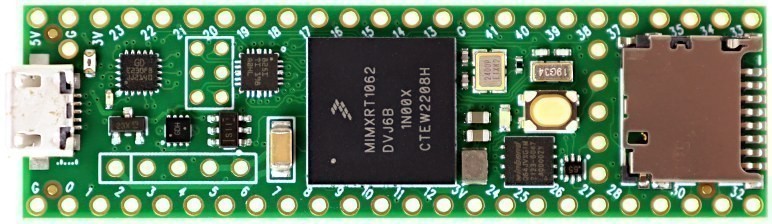
The Teensy 4.1 is a 600MHz ARM Cortex-M7 microcontroller with 1MB SRAM, 8MB flash, Ethernet, 8 UARTs, 3 CAN buses, USB host, audio I/O, and 55 GPIO pins in a breadboard-friendly form factor. It is the fastest microcontroller board in this comparison by a wide margin, purpose-built for audio processing, real-time DSP, and high-speed data acquisition.
Best for audio DSP and high-speed real-time processing, skip if you need WiFi or BLE on the board.
Where to Buy
Pros
- 600MHz Cortex-M7 — fastest microcontroller in this comparison by 2.5x
- 1MB SRAM with 512KB tightly-coupled for zero-wait-state access
- Native audio I/O with I2S and S/PDIF for professional audio projects
- 8 UARTs, 3 CAN buses, USB host — industrial-grade I/O density
- SDIO MicroSD for high-speed 4-bit data logging
Cons
- No WiFi or Bluetooth — requires external module for wireless
- No official Arduino board manager support — uses custom Teensyduino add-on
- Higher price than ESP32 boards (but justified by the 600MHz M7)
Raw Processing Speed
At 600MHz, the Teensy 4.1's Cortex-M7 is 2.5x faster than the ESP32-S3 (240MHz) and 37x faster than the Arduino Nano Every (16MHz). The M7 architecture includes hardware floating-point (both single and double precision), DSP instructions, and a large instruction cache. The NXP i.MX RT1062 chip at its core was designed for industrial real-time applications, and it shows in every benchmark. CoreMark scores exceed 3000, placing it firmly in territory usually occupied by application processors rather than microcontrollers.
The 512KB of tightly-coupled SRAM provides zero-wait-state access — critical for real-time audio where a cache miss can cause an audible glitch. Combined with the remaining 512KB of general SRAM, the Teensy has more fast memory than any other microcontroller board in this comparison. The tightly-coupled memory is split into two 256KB banks (DTCM and ITCM) that can be accessed simultaneously by the CPU, enabling data and instruction fetches in the same clock cycle. For DSP workloads that operate on large buffers — FFT analysis, FIR filters, convolution reverb — this memory architecture eliminates the stalls that would cripple audio quality on lesser chips.
The double-precision floating-point unit deserves special attention. Most microcontrollers with FPUs handle only single-precision (32-bit) floats. The Teensy 4.1 executes double-precision (64-bit) operations in hardware, which matters for scientific data acquisition, precise sensor calibration, and GPS coordinate processing. The ESP32-S3 must emulate double-precision in software, taking 10-20x longer per operation.
Audio Processing and MIDI
The Teensy Audio Library is the reason many audio engineers choose this board. It provides a visual drag-and-drop Audio System Design Tool — a browser-based GUI where you wire together 100+ processing blocks: oscillators, filters, mixers, delays, FFT analysis, envelope followers, and effects. Click export and it generates Arduino-compatible C++ code. The 600MHz M7 handles complex audio chains in real-time at 44.1kHz with CPU headroom to spare — typical audio projects use 5-15% of available processing power, leaving room for polyphony and effects stacking.
Hardware I2S connects directly to audio DACs and ADCs without CPU overhead. The Audio Shield (Rev D) pairs an SGTL5000 codec with headphone amp, line in/out, and MicroSD for sample playback — the complete audio I/O solution for under $15. S/PDIF provides digital audio input and output at professional quality. USB Audio turns the Teensy into a class-compliant USB sound card recognized by any DAW (Ableton, Logic, Reaper) without drivers. USB MIDI makes it appear as a native MIDI device, and you can run both USB Audio and USB MIDI simultaneously — a feature that commercial MIDI controllers costing hundreds of dollars rely on.
For guitar effects pedals, the Teensy processes audio with sub-millisecond latency — imperceptible to any player. A typical signal chain (input buffer, noise gate, distortion, parametric EQ, chorus, delay, reverb) uses roughly 30% CPU at 600MHz. The ESP32-S3 at 240MHz struggles with more than two or three effects in series before audio glitches appear. For polyphonic synthesizers, the Teensy can generate 16+ simultaneous voices with wavetable synthesis, each with independent filter and envelope — enough for a fully playable keyboard instrument.
USB Host, Ethernet, and Industrial I/O
The Teensy 4.1 is the only microcontroller board in this comparison with a native USB host port. This means it can act as the host for USB devices — plug in a USB MIDI keyboard, a USB barcode scanner, a USB game controller, or a USB flash drive directly. No USB-to-serial adapters, no shields, no bit-banging. The USB host stack supports HID devices, mass storage, MIDI controllers, and serial devices out of the box.
The built-in 10/100 Ethernet PHY (with the optional $5 Ethernet kit) provides wired networking without WiFi's latency and reliability issues. For stage lighting control (Art-Net/sACN), OSC-based music control, or industrial data acquisition, wired Ethernet delivers deterministic latency that WiFi cannot guarantee. Combined with 8 hardware UARTs and 3 CAN bus interfaces, the Teensy 4.1 handles automotive telemetry, industrial sensor networks, and multi-protocol gateways that would require multiple ESP32 boards to replicate.
The SDIO-connected MicroSD slot operates in 4-bit mode, delivering sustained write speeds of 20+ MB/s — fast enough to log high-sample-rate data from multiple sensors simultaneously. The ESP32's SPI-connected SD card interface typically maxes out at 2-4 MB/s. For data acquisition systems sampling accelerometers, strain gauges, or audio at 44.1kHz across multiple channels, the SDIO interface ensures no samples are dropped.
Audio and Real-Time Performance
The Teensy Audio Library, maintained by Paul Stoffregen (PJRC founder), is the reason the Teensy 4.1 dominates the DIY audio and music hardware scene. The library provides over 100 audio processing blocks — oscillators (sine, saw, square, triangle, arbitrary wavetable), filters (biquad, state variable, FIR with up to 200 taps), effects (chorus, flange, delay, granular, reverb), analysis (FFT 1024-point in under 1ms, peak, RMS), and mixers — all designed for real-time operation at 44.1kHz / 16-bit. The Audio System Design Tool, a browser-based GUI at pjrc.com/teensy/gui, lets you visually wire these blocks together and export Arduino-compatible C++ code. No other microcontroller ecosystem offers anything comparable.
The 600MHz Cortex-M7 with hardware single- and double-precision floating-point processes audio with latency under 3 milliseconds from input to output — below the human perception threshold of approximately 10ms for live performance. A typical guitar effects chain (input buffer, noise gate, three-band parametric EQ, overdrive, chorus, stereo delay, plate reverb) uses roughly 25-30% of the CPU at 600MHz, leaving substantial headroom for additional effects or polyphonic synthesis. The ESP32-S3 at 240MHz can handle basic audio (single oscillator, simple filter) but begins dropping samples when more than two or three effects are chained — audible as clicks, pops, and glitches that are unacceptable in a performance instrument.
USB Audio class compliance means the Teensy appears as a native sound card on macOS, Windows, and Linux without drivers. USB MIDI runs simultaneously on the same USB connection — the board can be both a MIDI controller and an audio interface at once, a capability that commercial products like the Teenage Engineering OP-1 and Arturia MicroFreak rely on dedicated chips to achieve. The DIY synthesizer and MIDI controller community has standardized on Teensy precisely because no Arduino, ESP32, or Raspberry Pi Pico matches this combination of raw DSP performance, sub-millisecond latency, simultaneous USB Audio + MIDI, and a mature audio library with a visual design tool. For anyone building a custom synthesizer, drum machine, effects pedal, or sample player, the Teensy 4.1 is the only serious microcontroller option.
Full Specifications
Processor
| Specification | Value |
|---|---|
| Architecture | ARM Cortex-M7 [1] |
| CPU Cores | 1 [1] |
| Clock Speed | 600 MHz [1] |
Memory
| Specification | Value |
|---|---|
| Flash | 8 MB [1] |
| SRAM | 1024 KB [1] |
| ram_type | 1MB SRAM (512KB tightly-coupled) [1] |
Connectivity
| Specification | Value |
|---|---|
| ethernet | 10/100 Ethernet (PHY on board) [1] |
I/O & Interfaces
| Specification | Value |
|---|---|
| GPIO Pins | 55 [1] |
| ADC Channels | 18 [1] |
| dac_channels | 2 [1] |
| SPI | 3 [1] |
| I2C | 3 [1] |
| UART | 8 [1] |
| USB | USB-C (native USB 480Mbps) [1] |
| usb_host | USB Host port (5-pin) [1] |
| audio | 2x I2S, 1x S/PDIF in/out [1] |
| can_bus | 3x CAN bus (FlexCAN) [1] |
| SD Card | SDIO MicroSD slot (4-bit) [1] |
Power
| Specification | Value |
|---|---|
| Input Voltage | 3.6-5.5 V [1] |
Physical
| Specification | Value |
|---|---|
| Dimensions | 61 x 18 mm [1] |
| Form Factor | Teensy (breadboard-friendly) [1] |
Who Should Buy This
600MHz M7 processes audio in real-time with headroom. I2S and S/PDIF connect to DACs and ADCs. The Audio library provides 100+ audio processing blocks. USB MIDI for controller input. Nothing else in this price range handles audio this well.
No wireless — massive overkill for sensor reading. An ESP32-C3 at $7 with WiFi + BLE handles this perfectly at 1/10th the cost.
Better alternative: ESP32-C3-DevKitM-1
3 CAN buses read multiple vehicle networks simultaneously. 600MHz processes data in real-time. SDIO MicroSD logs at high speed. Ethernet connects to pit crew telemetry. 8 UARTs for additional serial sensors.
Ecosystem & Community
Teensy's ecosystem is built around PJRC's audio library and the Teensy Audio System Design Tool — a web-based GUI for designing audio processing pipelines. The 600MHz Cortex-M7 with hardware floating point makes it the standard for DIY synthesizers, MIDI controllers, and audio effects processors.
Compatible Software
What to Build First
Build a USB-native audio synthesizer using Teensy's Audio Library and the Audio System Design Tool. Wire up potentiometers and buttons, design your audio pipeline in the browser GUI, and have a working polyphonic synthesizer that appears as a USB audio device on any computer.
View tutorial →Must-Have Accessories
Tutorials & Resources
- PJRC Teensy TutorialsOfficial tutorials covering USB, audio, Ethernet, and real-time programmingtutorial
- Teensy Audio System Design ToolWeb-based GUI for designing audio processing pipelines — generates Arduino codedocs
- PJRC ForumActive community forum with decades of Teensy projects and troubleshootingdocs
- Teensy CoresCore library for all Teensy boards — hardware abstraction and USB stackgithub
Frequently Asked Questions
Why choose Teensy over ESP32 for audio?
The 600MHz M7 has 2.5x more raw processing power than the ESP32-S3, plus dedicated audio hardware (I2S, S/PDIF) and the Teensy Audio Library with 100+ processing blocks. The ESP32 can do basic audio, but the Teensy handles professional-quality real-time DSP.
Can the Teensy 4.1 connect to WiFi?
Not natively. You need an external ESP32 or WiFi module connected via serial. For WiFi-centric projects, use an ESP32 directly. The Teensy is for projects where raw processing speed matters more than wireless connectivity.
Does the Teensy work with Arduino IDE?
Yes, via the Teensyduino add-on. Most Arduino libraries work. The Teensy also supports PlatformIO and its own build system. It is not in the official Arduino Board Manager — you install Teensyduino separately.
Teensy 4.1 vs Teensy 4.0: what changed?
The 4.1 adds Ethernet, USB host, SDIO MicroSD, more GPIO pins (55 vs 40), and more flash (8MB vs 2MB). Same 600MHz M7 processor and 1MB SRAM. The 4.1 is the clear choice for new projects.
Is 1MB SRAM enough?
For audio and DSP, yes — it is far more than any other microcontroller offers. For large data buffers, the SDIO MicroSD provides fast external storage. For image processing or ML, the ESP32-S3 with 8MB PSRAM is a better fit.
Compared In
Teensy 4.1 appears in 2 buying guides on PAM Finds. These weigh it directly against the alternatives.