BIGTREETECH EBB36 CAN V1.2
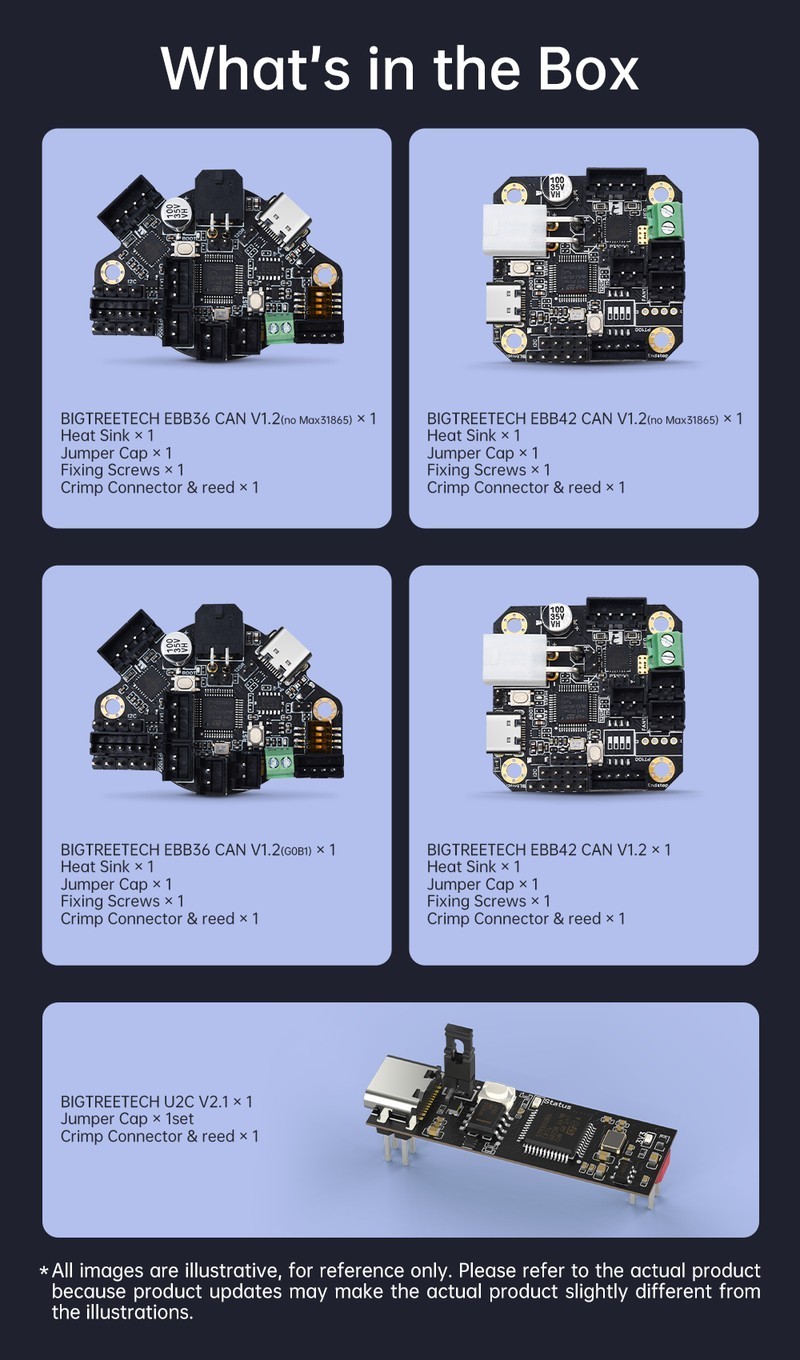
The BTT EBB36 CAN is a compact toolhead controller board featuring an STM32G0B1 MCU, one onboard TMC2209 driver, CANFD communication, and ports for a hotend heater, 3 fans, and a probe — all on a 36mm-wide PCB that mounts directly behind a NEMA17 stepper motor. At $28, it reduces the cable bundle to the printhead to just 4 wires.
The standard CAN toolhead board for Voron Stealthburner — essential for clean wiring on CoreXY printers.
Where to Buy
Pros
- Reduces printhead wiring from 10+ wires to a 4-wire CAN cable (power, ground, CAN-H, CAN-L)
- Onboard TMC2209 drives the extruder stepper directly at the toolhead — shorter motor cable, less noise
- CANFD support at up to 5Mbit/s for reliable communication and accelerometer data streaming
- 36mm width matches NEMA17 motor mounting pattern — clean mechanical integration
Cons
- Requires CAN bus infrastructure — a U2C bridge or CAN-capable mainboard like the Octopus or Manta M8P
- Only 1 stepper driver — cannot run dual extruders from one EBB36
- CANFD cable routing still requires planning — the 4-wire cable must handle drag chain flex cycles
Wiring Reduction
The EBB36's primary purpose is eliminating the cable bundle between the mainboard and the printhead. A typical CoreXY toolhead requires wires for: extruder stepper (4), hotend heater (2), thermistor (2), part cooling fan (2), hotend fan (2), probe (3), and optionally an accelerometer (4) and filament sensor (2). That is 15-21 individual wires routing through a cable drag chain.
With the EBB36, all those components connect locally at the toolhead. Only 4 wires run back to the mainboard: 24V power, ground, CAN-H, and CAN-L. This reduces cable weight by approximately 70%, decreases drag chain stress, and eliminates the most common failure point on CoreXY printers — broken wires from repeated flex cycles in the cable chain.
Onboard Features
The STM32G0B1 MCU runs Klipper firmware locally, handling extruder stepper control, heater PWM, fan speed, thermistor reading, and probe signals. The onboard TMC2209 drives the extruder stepper directly, meaning the motor cable is just 30-50mm long from the EBB36 to the stepper — eliminating electrical noise from long motor cables.
Three fan outputs support the typical toolhead configuration: part cooling (PWM-controllable), hotend fan (always-on or thermally controlled), and an auxiliary fan for electronics cooling or chamber air circulation. The probe port supports BLTouch, CR Touch, Klicky, and other common probes. An onboard ADXL345 accelerometer footprint allows direct mounting for input shaper calibration without additional wiring.
CAN vs USB: Why CAN Wins for Toolheads
CAN bus was not invented for 3D printers. It was developed by Bosch in 1986 for automotive wiring — replacing dozens of dedicated wires between engine sensors, ABS modules, and instrument clusters with a single twisted-pair bus. The protocol was engineered for environments where electrical noise is constant and communication failure means a car crash. That automotive heritage is exactly why CAN outperforms USB for toolhead communication in the electrically hostile environment inside a 3D printer enclosure.
The critical advantage is differential signaling. CAN transmits data as the voltage difference between CAN-H and CAN-L lines. When electromagnetic interference from stepper motors, heater PWM switching at 25kHz, and 24V power supply ripple couples into the cable, it affects both lines equally — the difference remains unchanged, and the data arrives intact. USB uses single-ended signaling referenced to ground, making it vulnerable to EMI-induced bit errors and ground loop issues. In a 3D printer, the ground plane carries return current from stepper drivers switching at tens of kilohertz. A USB cable running alongside stepper motor cables picks up this noise directly, corrupting data frames.
Community reports on the Klipper subreddit and Voron Discord consistently document the failure pattern with USB toolhead connections. Intermittent communication timeouts appear during fast retractions at 60mm/s and high-frequency input shaper sweeps above 100Hz — precisely the conditions that generate the most electrical noise from rapid stepper motor direction changes. Users report print failures mid-layer with MCU communication timeout errors in the Klipper log. The same toolhead hardware running CAN instead of USB reports zero communication errors under identical conditions, because the differential signaling rejects the common-mode noise that USB cannot filter.
Beyond noise immunity, CAN includes protocol-level error handling that USB lacks for this use case. Every CAN frame carries a 15-bit CRC for error detection. If a frame arrives corrupted, the receiving node signals an error and the sender automatically retransmits — all handled in hardware by the STM32G0B1's CAN peripheral, with no software overhead. USB also has CRC checking, but USB serial communication as used by Klipper operates over a virtual COM port abstraction that does not expose hardware retransmission to the application layer. A corrupted USB frame results in a Klipper timeout and potential print failure.
Reliability data from Voron community build logs tells the story in numbers. USB toolhead setups report a 5-10% rate of communication-related print failures over 6 months of active use. CAN bus setups report under 1% over the same period. The gap widens in enclosed printers where ambient temperatures reach 50-60C, because heat increases electrical resistance variations that exacerbate ground loop issues on USB connections. This reliability difference is why virtually all new Voron 2.4 and Trident builds in 2025-2026 are CAN-first — the community has collectively learned that USB toolhead connections are the single weakest link in an otherwise reliable motion system, and the $28 cost of a CAN toolhead board is trivial insurance against ruined 20-hour prints.
The bandwidth question occasionally surfaces in discussions, but it is a non-issue in practice. Standard CAN at 1Mbit/s provides more than enough throughput for all toolhead communication: stepper commands, thermistor readings, fan speed updates, and probe signals combined consume a fraction of the available bandwidth. CANFD at 5Mbit/s, supported by the EBB36's STM32G0B1, adds headroom for accelerometer data streaming during input shaper calibration — the most bandwidth-intensive toolhead operation. Even with an ADXL345 streaming acceleration samples at 3.2kHz on three axes, CANFD handles the data without congestion. The practical takeaway is simple: for any toolhead on a CoreXY printer with a cable drag chain, CAN is strictly superior to USB in noise immunity, reliability, error recovery, and cable simplicity. The only reason to use USB for a toolhead in 2026 is if you already own the hardware and refuse to spend $28 on an upgrade. For builders starting fresh with a new CoreXY build, the EBB36 with CAN is not an upgrade — it is the baseline. Start with CAN, skip the USB toolhead phase entirely, and save yourself the inevitable rewiring when USB communication failures ruin your third long overnight print.
Full Specifications
Processor
| Specification | Value |
|---|---|
| Architecture | ARM Cortex-M0+ [1] |
| CPU Cores | 1 [1] |
| Clock Speed | 64 MHz [1] |
I/O & Interfaces
| Specification | Value |
|---|---|
| Stepper Drivers | 1 (TMC2209 onboard) [1] |
| Thermistor Inputs | 1 (NTC 100K) [1] |
| Heater Outputs | 1 (hotend) [1] |
| Fan Ports | 3 (1 heatsink + 2 part cooling) [1] |
| CAN Bus | CANFD (1Mbps) [1] |
| USB | USB-C (flashing) [1] |
| Probe Port | BLTouch, proximity sensor [1] |
Power
| Specification | Value |
|---|---|
| Input Voltage | 12-24 V [1] |
Physical
| Specification | Value |
|---|---|
| Dimensions | 36 x 36 mm [1] |
| Form Factor | CAN bus toolhead board (NEMA17 mount) [1] |
Who Should Buy This
The EBB36 is the community standard for Voron Stealthburner builds. It replaces the long cable chain with a 4-wire CAN cable. The onboard TMC2209 drives the extruder stepper directly, and the 36mm width matches the NEMA17 mounting pattern.
On CoreXY printers, the toolhead moves on two axes with cable drag. Reducing 10+ signal wires to 4 dramatically reduces cable weight, drag, and failure points. The 3 fan outputs handle part cooling, hotend, and aux fans.
Bed-slinger printers have a short, fixed cable path to the toolhead. CAN bus adds cost and complexity without meaningful wiring benefit. The stock wiring or a direct cable extension works fine.
You need a U2C USB-to-CAN bridge ($15) between the mainboard and the EBB36. The total cost is $43 for the EBB36 + U2C. Mainboards with native CAN (Octopus V1.1, Manta M8P) eliminate the U2C.
Better alternative: BIGTREETECH U2C V2.1
If configuring firmware and wiring stepper drivers feels like a lot, the Bambu Lab A1 Mini prints out of the box for under $200.
Better alternative: Bambu Lab A1 Mini
Ecosystem & Community
The EBB36 is the standard CAN bus toolhead board for Voron Stealthburner. It reduces printhead wiring to 4 wires (power, ground, CAN-H, CAN-L) and communicates at up to 1Mbit/s. CanBoot enables firmware updates over CAN without physical access.
Compatible Software
What to Build First
Replace the entire printhead cable bundle (8+ wires for heater, thermistor, fans, probe, stepper) with a single 4-wire CAN cable. The EBB36 handles all toolhead I/O locally, communicating via CAN bus to the mainboard.
View tutorial →Must-Have Accessories
Video Reviews & Tutorials
Tutorials & Resources
- BTT EBB36 WikiOfficial pinout, wiring diagrams, and firmware instructionsdocs
- CanBoot BootloaderCAN bootloader enabling firmware updates without USB connectiongithub
- Klipper CAN Bus DocsOfficial Klipper CAN bus configuration referencegithub
Frequently Asked Questions
Do I need a U2C bridge to use the EBB36?
Only if your mainboard does not have native CAN bus. The Octopus V1.1 and Manta M8P have CAN headers. For mainboards without CAN (like the SKR Mini E3), you need a BTT U2C V2.1 ($15) as a USB-to-CAN bridge.
What is the difference between the EBB36 and EBB42?
The EBB42 is wider (42mm) to match NEMA17 42mm motor mounting patterns. The EBB36 is 36mm wide for compact toolheads like the Voron Stealthburner. Electrically they are identical — same MCU, same TMC2209, same CAN interface.
Can the EBB36 drive two extruder steppers?
No. The EBB36 has one TMC2209 driver for one extruder stepper. For dual extruders at the toolhead, you would need two EBB36 boards or a different toolhead controller. Most dual-extruder setups drive the second extruder from the mainboard.
Does the EBB36 support input shaper calibration?
Yes. The EBB36 has pads for an onboard ADXL345 accelerometer. Solder the accelerometer and run Klipper's input shaper calibration directly from the toolhead — no additional wiring or separate accelerometer board needed.
How reliable is CAN bus communication for 3D printing?
Very reliable. CAN bus was designed for automotive environments with electrical noise. At 1Mbit/s (or 5Mbit/s with CANFD), it includes error detection and automatic retransmission. Communication errors are rarer than with USB connections in noisy printer environments.
What cable do I need for the CAN connection?
A 4-wire cable: 24V power, ground, CAN-H, and CAN-L. Use twisted-pair wire for the CAN signals. The cable runs through the cable drag chain to the mainboard or U2C bridge. Total cable thickness is significantly less than the 10+ wire bundle it replaces.
Is the EBB36 worth it for a bed-slinger printer like the Ender 3?
Generally no. Bed-slinger toolheads have a short, fixed cable path with minimal flex. CAN bus solves a wiring problem that bed-slingers do not have. The cost ($28 board + $15 U2C) is better spent on a mainboard upgrade.
Compared In
BIGTREETECH EBB36 CAN V1.2 appears in 1 buying guide on PAM Finds. These weigh it directly against the alternatives.