Makerbase MKS SKIPR
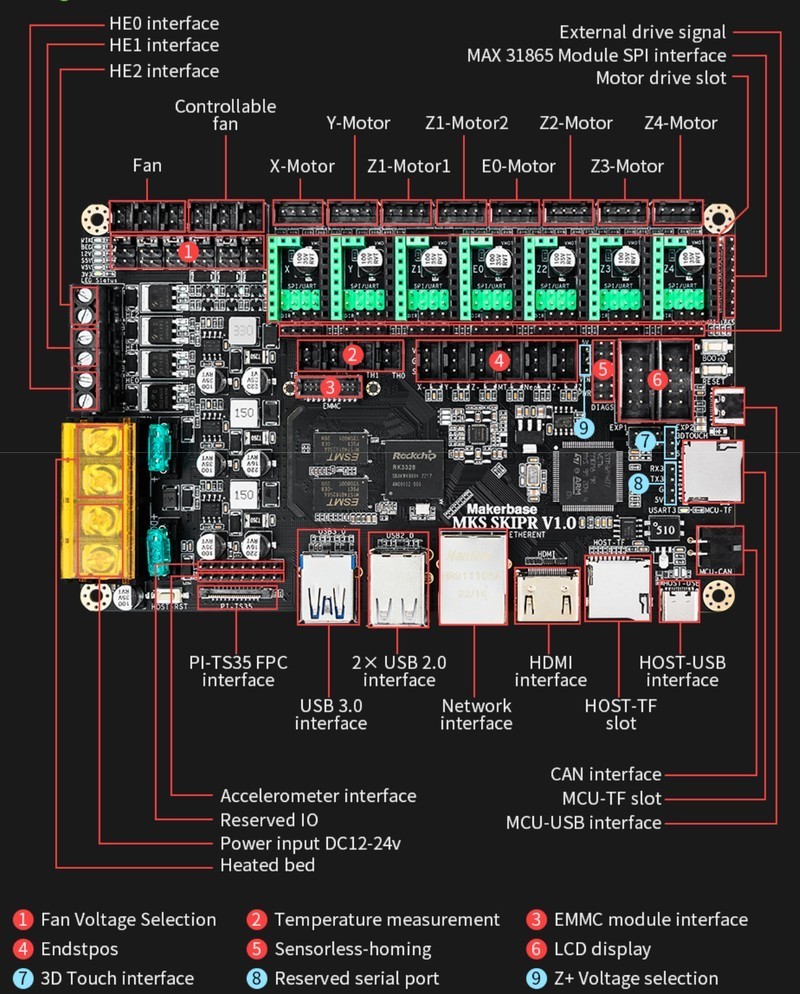
The MKS SKIPR is a budget 3D printer mainboard built on the STM32F407 at 168MHz, offering 7 plug-in stepper driver slots and a Raspberry Pi 40-pin header for direct SBC mounting. At $55, it undercuts the BTT Octopus V1.1 by $10 while integrating a Pi header that eliminates a separate USB connection.
A solid budget Voron board — just know the community is smaller than BTT's.
Where to Buy
Pros
- 7 plug-in stepper driver slots cover Voron 2.4's 6-stepper requirement plus one spare
- Raspberry Pi 40-pin GPIO header provides direct SBC connection without USB cable
- $55 price undercuts the Octopus V1.1 by $10 and includes the Pi header
- STM32F407 at 168MHz is adequate for Klipper with all common kinematics
Cons
- Smaller community than BTT — fewer configs, guides, and troubleshooting resources
- STM32F407 at 168MHz is slower than the Octopus V1.1's STM32F446 at 180MHz
- No CAN bus support — toolhead boards must connect via USB
- Only 4 fan headers versus the Octopus V1.1's 6
Budget Positioning and Trade-offs
The MKS SKIPR occupies a specific niche: builders who want 7+ driver slots and an integrated SBC connection for less than $60. At $55, it costs $10 less than the BTT Octopus V1.1 ($65) and $44 less than the Manta M8P V2 ($99). The 40-pin Raspberry Pi header eliminates the USB cable between the Pi and the mainboard, resulting in cleaner wiring and one fewer cable to route through the electronics bay.
The trade-off is community size. MakerBase (MKS) has a smaller user base than BigTreeTech (BTT) in the Voron community. When you hit a configuration issue — a stepper driver that won't initialize, a fan header that behaves unexpectedly, or a pin conflict with a sensor — you will find fewer SKIPR-specific answers on GitHub, Discord, and Reddit compared to the Octopus. Most SKIPR users adapt Octopus Klipper configs by remapping pins, which works but adds 30-60 minutes of setup time as you cross-reference the SKIPR pinout against the Octopus config.
The $10 savings is real but small in the context of a full Voron build that typically costs $500-$1000 in parts. The question is whether that $10 justifies the thinner documentation. For experienced builders who are comfortable reading schematics and adapting pin configurations, the SKIPR is a perfectly capable board. For first-time builders who want the path of least resistance, the Octopus's documentation advantage is worth the extra $10.
Hardware Capabilities
The STM32F407 at 168MHz runs Klipper reliably for all common kinematics including CoreXY, delta, and cartesian. It is slightly slower than the Octopus V1.1's STM32F446 at 180MHz, but this 7% difference is negligible for Klipper's motion planning workload — both MCUs process stepper timing with microsecond precision at typical print speeds. The performance gap only becomes relevant at extreme velocities (500+ mm/s) with complex path geometry, which is not a realistic operating point for most SKIPR-based builds.
Seven plug-in driver slots accept any Pololu-form-factor driver: TMC2209 for quiet operation, TMC5160 for high-current or high-voltage stepper drives, TMC2226 for improved thermal performance, or budget DRV8825. For a Voron 2.4, this means 2 AB drivers, 4 Z drivers, and 1 extruder — exactly 7. There is no spare slot for a future second extruder without re-configuring the Z axis to use fewer independent drivers (e.g., paralleling two Z motors on one driver). The Octopus V1.1's 8th slot provides that breathing room.
The 4 fan headers are adequate for a standard Voron (hotend fan, part cooling fan, electronics bay fan, exhaust fan) but leave no spare for additional chamber fans, per-driver cooling fans, or filament dryer fans without using a fan splitter board. The Octopus's 6 fan headers provide more flexibility. If your build requires more than 4 independently controlled fans, factor in a $5-10 fan expansion board or choose the Octopus.
The Raspberry Pi GPIO Connection
The SKIPR's integrated 40-pin Raspberry Pi GPIO header is its most distinctive feature versus BTT mainboards. Instead of connecting the Pi to the mainboard via USB (the standard approach with the Octopus), the Pi mounts directly onto the SKIPR's header and communicates via GPIO UART. This eliminates the USB cable entirely and provides a more reliable serial connection that is not susceptible to USB cable quality issues, EMI interference, or USB hub congestion.
The GPIO connection works with any Raspberry Pi model that has a 40-pin header: Pi 3B+, Pi 4 (any RAM variant), Pi 5, or Pi Zero 2 W. The Pi draws power from the SKIPR's 5V rail, so no separate USB power supply is needed for the Pi. This simplifies the power chain: one 24V PSU feeds the SKIPR, which in turn powers both the stepper drivers and the Pi host. However, the Pi's 5V power draw (2-3A for a Pi 4 under load) must be within the SKIPR's regulator capacity — verify the SKIPR's 5V regulator is rated for the combined load of the Pi plus any USB devices connected to the Pi.
In practice, the GPIO UART connection works identically to USB from Klipper's perspective — the configuration simply specifies the serial device path for UART instead of USB. The advantage is purely physical: cleaner wiring, no cable to fail, and a more compact electronics bay layout with the Pi stacked directly on the mainboard.
Firmware Support and Updates
MakerBase releases firmware updates and Klipper board definitions less frequently than BigTreeTech, and this has practical consequences for builders who keep their Klipper installations current. The Klipper project's board definition for the SKIPR exists in the official repository, but it receives fewer community contributions than BTT boards like the Octopus V1.1 or Manta M8P. When Klipper's development branch introduces new features — improved input shaping algorithms, new kinematics support, expanded macro capabilities, or changes to the MCU communication protocol — the SKIPR's board definition may lag behind in testing and validation.
The practical impact shows up during Klipper updates. BTT boards typically have same-day or same-week community verification when a new Klipper release drops. Voron Discord and the Klipper subreddit light up with users reporting successful updates on Octopus and Manta boards, sharing updated config snippets, and flagging any breaking changes. For the SKIPR, this community feedback loop is slower. You might wait days or weeks before another SKIPR user confirms that the latest Klipper version works without regressions on the STM32F407 with the SKIPR's specific pin mapping.
MakerBase's own firmware repository on GitHub also updates less frequently than BTT's. Sample Klipper configs, pin definition files, and documentation revisions arrive in batches rather than continuously. BTT maintains active GitHub repositories with issue tracking, pull request reviews, and regular releases for each board. MKS repositories tend toward periodic large updates with less granular change tracking, making it harder to identify what changed between versions or to bisect a configuration issue to a specific firmware revision.
For builders who flash Klipper once and run it for months without updating, this difference is negligible — the SKIPR's board definition is stable and functional. For builders who update Klipper frequently to access new features, run development branches, or contribute to Klipper development, BTT boards offer a faster community response cycle and lower risk of encountering untested edge cases after an update. If you choose the SKIPR, pinning your Klipper version and updating deliberately (after checking community reports) rather than running the latest commit is the pragmatic approach.
Full Specifications
Processor
| Specification | Value |
|---|---|
| Architecture | ARM Cortex-M4 [1] |
| CPU Cores | 1 [1] |
| Clock Speed | 168 MHz [1] |
I/O & Interfaces
| Specification | Value |
|---|---|
| Stepper Drivers | 7 (plug-in) [2] |
| Driver Type | TMC2209, TMC5160 compatible [2] |
| Thermistor Inputs | 3 [2] |
| Heater Outputs | 3 (2 hotend + 1 bed) [2] |
| Fan Ports | 5 [2] |
| Probe Port | BLTouch compatible [2] |
| CAN Bus | No [2] |
| USB | USB-C [2] |
| SBC Socket | RPi header (40-pin) [2] |
Power
| Specification | Value |
|---|---|
| Input Voltage | 12-24 V [1] |
Physical
| Specification | Value |
|---|---|
| Dimensions | 151 x 104 mm [2] |
| Form Factor | Printer mainboard [2] |
Who Should Buy This
At $55 with 7 driver slots and a Pi header, the SKIPR costs $10 less than the Octopus V1.1 while integrating the SBC connection. The 7th driver slot covers a spare or second extruder.
The MKS SKIPR has no CAN bus header. For CAN toolhead setups with an EBB36, the Octopus V1.1 or Manta M8P with native CAN support is required.
Better alternative: BIGTREETECH Octopus V1.1
The Octopus V1.1 has more Voron community configs, wiring guides, and troubleshooting threads. The SKIPR works but you will find fewer reference configurations and may need to adapt BTT configs.
Better alternative: BIGTREETECH Octopus V1.1
The Ender 3 needs 4 drivers and a compact board. The SKIPR is too large and has too many drivers for a bed-slinger. The SKR Mini E3 V3 is a purpose-built drop-in replacement.
Better alternative: BIGTREETECH SKR Mini E3 V3.0
If configuring firmware and wiring stepper drivers feels like a lot, the Bambu Lab A1 Mini prints out of the box for under $200.
Better alternative: Bambu Lab A1 Mini
Ecosystem & Community
MKS has a smaller community than BTT but offers competitive hardware at lower prices. The SKIPR's integrated Pi header differentiates it, though documentation is thinner and community Klipper configs are harder to find than BTT equivalents.
Compatible Software
What to Build First
Mount a Raspberry Pi directly to the SKIPR's 40-pin header, flash Klipper, and run a full Voron build for $10 less than BTT alternatives. The integrated header eliminates USB connection issues.
View tutorial →Must-Have Accessories
Tutorials & Resources
- MKS WikiSetup guide and wiring documentation for Voron buildsdocs
- MKS SKIPR RepositoryOfficial schematic, pinout, firmware binaries, and sample Klipper configsgithub
- Klipper FirmwareOpen-source firmware with STM32F407 board supportgithub
Frequently Asked Questions
Does the MKS SKIPR work with Klipper?
Yes. The STM32F407 is supported by Klipper. You will need to compile Klipper firmware using the correct pin configuration for the SKIPR. Community-contributed configs exist, though fewer than for BTT boards.
How does the SKIPR compare to the BTT Octopus V1.1?
The SKIPR costs $10 less, has 7 driver slots (vs 8), includes a Pi GPIO header (Octopus needs USB), but lacks CAN bus support. The Octopus has more community documentation and 6 fan headers (vs 4). Both run Klipper well.
Can I use TMC5160 drivers with the MKS SKIPR?
Yes. All 7 driver slots accept plug-in drivers including TMC5160 for high-current or high-voltage stepper applications. Configure via SPI in Klipper.
Does the SKIPR support CAN bus toolhead boards?
No. The SKIPR has no CAN bus transceiver or header. Toolhead boards like the EBB36 must connect via USB through the Raspberry Pi. For native CAN bus, choose the Octopus V1.1 or Manta M8P.
What Raspberry Pi models work with the SKIPR's GPIO header?
Any Raspberry Pi with a 40-pin GPIO header: Pi 3B+, Pi 4, Pi 5, or Pi Zero 2 W. The Pi connects directly to the SKIPR via GPIO UART, eliminating the USB cable used with other mainboards.
Is the MKS SKIPR good for a first Voron build?
It works, but first-time Voron builders benefit from the larger BTT community. The Octopus V1.1 has more step-by-step guides, Discord channels, and configuration examples. The SKIPR is better for experienced builders who are comfortable adapting configs.
How many fan headers does the MKS SKIPR have?
4 controllable fan headers. This covers the standard Voron fan setup (hotend, part cooling, electronics bay, exhaust) but leaves no spare for additional chamber fans or per-driver cooling without a fan splitter.
Compared In
Makerbase MKS SKIPR appears in 1 buying guide on PAM Finds. These weigh it directly against the alternatives.